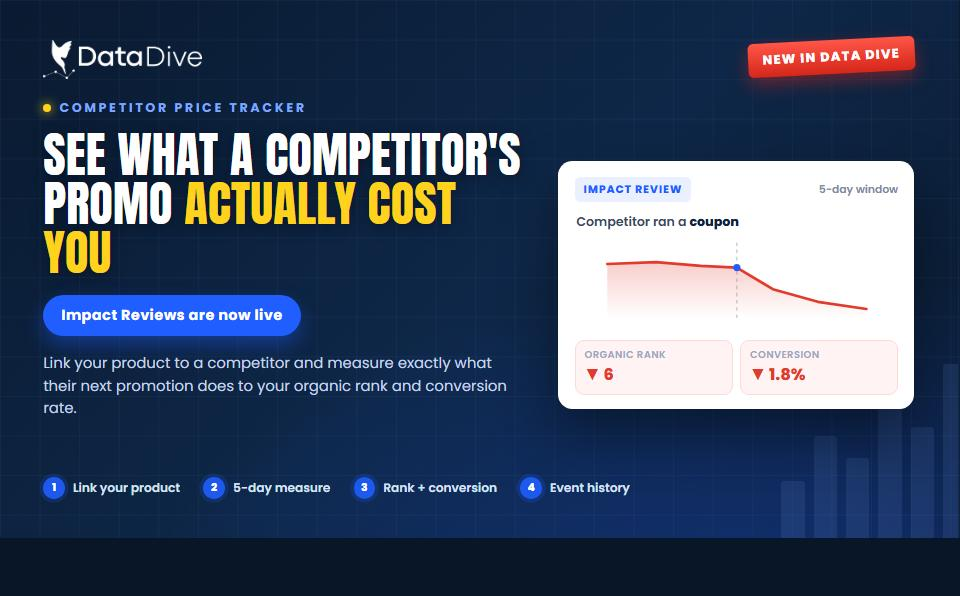
Data Dive’s Competitor Price Tracker Now Gives Impact Review What a Competitor’s Promo Actually Cost You
Your rank slipped last Tuesday. Was that something you did, or something a competitor did? Until now, Competitor Price Tracker could tell
Amazon FBA means Fulfilled by Amazon. You ship your products to Amazon’s warehouses and Amazon handles storage, picking, packing, delivery, customer service, and returns. Many sellers choose this model because it removes the need to build their own warehouse or shipping operation, allowing them to focus on product selection, branding, and marketing.
Amazon is still the leader in ecommerce, with an estimated 12.87M orders daily. Independent sellers generate over 60 percent of sales in the Amazon store, and in 2024 US based sellers averaged about 290,000 dollars in annual sales.
Amazon handles fulfillment of your products, which simplifies your ecommerce business. Amazon takes care of logistical challenges like storage, packaging, shipping, and returns. This empowers sellers to focus on growing the business, not busy work.
Amazon FBA provides sellers with comprehensive data so business owners can ensure they are selling the right products at the right price to the right people (and ranking highly for their keywords).
Amazon FBA creates a proven framework in a growing industry, which is why it is so popular for ecommerce sellers. The key is combining getting a clear understanding of the data so you can make better decisions.
 | Successful FBA sellers treat product research as a crucial data project. Before spending money, they study search volume, seasonality, pricing, competitor quality, review velocity, and margin structure. In 2024, over 55,000 independent sellers crossed one million dollars in revenue, driven by a portfolio of carefully selected products. Data Dive brings these signals into view by simplifying Amazon FBA data. For example, a simple “Dive” reveals how competitive your desired niche is. You’ll quickly understand how many competitors rank for a keyword set, how concentrated sales are among the leaders, how prices behave across months, and how stable demand looks. Profit tools then add landed cost, FBA fees, shipping, and launch budgets so you can see whether a product actually leaves room for profit. |
Here’s an example of how the data can change your life as a seller.
Seller A is initially excited by high search volume tied to a seasonal spike. They place a large order, launch, and see short lived sales. Once the season passes, demand falls and inventory sits. Choosing the wrong product without proper data cost them thousands of dollars.
Seller B checks the same idea in Data Dive, reviews last year’s monthly search pattern, and sees demand concentrated in one event. That seller either plans a small, time bound launch or switches to a niche with year round demand.
 | Success on Amazon FBA depends on three forces: traffic, sales, and reviews. PPC drives traffic when your listing is new and ranking is building. Sponsored placements bring shoppers to your page and give Amazon data on which search terms match your product. Pay Per Click advertising campaigns rely on great data. Without structure, ad spend often flows into broad terms that attract clicks without buyers. CPCs rise, budgets drain, and sellers misjudge the product. Running ads without the right data lead to terrible results! Data Dive fixes this issue with clear, color coded signals. You’ll see keyword performance, ranking movement, and PPC exposure to confirm terms that help vs waste PPC ad spend. |
 | Ranking is the engine that drives consistent FBA sales after launch. Strong placement on page one brings impressions, clicks, and a higher chance of conversion. Once a product holds solid ranking across several core keywords, organic traffic carries a larger share of revenue and PPC moves into maintenance. Ranking depends on several signals working together: sales volume, keyword level conversion, listing relevance, price position, and customer satisfaction. When these signals stay healthy, ranking grows. When they weaken, visibility drops and recovery becomes harder. Data Dive helps structure this process. Keyword tracking shows whether a listing is gaining or losing ground. Listing analysis reveals gaps in keyword coverage, content strength, or imagery compared with niche leaders. Competitor comparisons show when others adjust price, add variations, or increase advertising so you can react early. |
Choosing the right product is the key to success on Amazon FBA.
Every product idea carries risk. Capital risk from buying inventory. Competitive risk from strong existing sellers. Demand risk from seasonality or market changes. Platform risk from compliance rules or category policies.
Data Dive helps you measure risk before committing to inventory. Scorecard views show how many competitors dominate the niche, how old their listings are, how many reviews they hold, and how broad their variation sets run.
Amazon FBA remains one of the most powerful opportunities in ecommerce because it pairs massive daily demand with a fulfillment system that removes nearly all operational complexity.
Success isn’t about luck with FBA, but rather product selection, understanding data, and navigating Amazon’s rules with confidence. With the right research and a clear view of competition, margins, and keyword demand, FBA becomes far more predictable and far less risky.
Tools like Data Dive gives aspiring sellers, seasoned vets, and agencies the clarity you need to make smart decisions from day one, helping you launch stronger, avoid costly mistakes, and build a real business in a growing marketplace.
Your rank slipped last Tuesday. Was that something you did, or something a competitor did? Until now, Competitor Price Tracker could tell

Amazon caps product titles at 75 characters on July 27, 2026. Here’s the full change, why it matters, and the step-by-step fix using Data Dive.