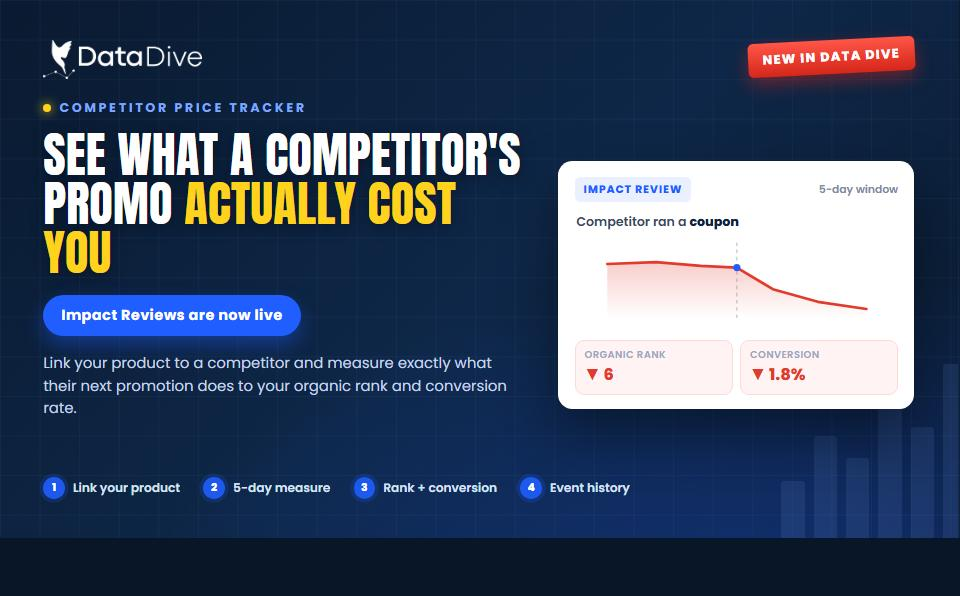
Data Dive’s Competitor Price Tracker Now Gives Impact Review What a Competitor’s Promo Actually Cost You
Your rank slipped last Tuesday. Was that something you did, or something a competitor did? Until now, Competitor Price Tracker could tell

Increasing profit on Amazon fba requires discipline in execution order. Many sellers attempt to scale revenue by increasing ad spend, launching new campaigns, or pushing traffic from external sources before strengthening their foundation. That approach often exposes weaknesses in conversion and indexing.
When sellers skip the first two steps, traffic amplifies inefficiencies. When those fundamentals are optimized first, advertising becomes a multiplier instead of a cost center.
Amazon rewards listings that convert well and rank broadly. The goal is profitable traffic.
Conversion rate is driven primarily by visual trust and clarity.
Buyers make decisions quickly. Your main image determines whether they click. Your secondary images determine whether they purchase. Every image must communicate quality, scale, and purpose immediately.
Several visual factors significantly influence conversion:
• The product should occupy as much of the frame as allowed without violating Amazon guidelines
• Texture and material detail should be visible when relevant
• Zoomed fabric swatches or close-ups increase perceived quality
• Packaging presentation should reinforce value if it enhances the offer
For textile products such as shower curtains, showing a close-up swatch of fabric texture has produced significant increases in conversion because customers can visually evaluate thickness and weave quality. This reduces hesitation.
AI tools can accelerate visual optimization. Sellers can prompt tools like ChatGPT to draft image briefs based on psychological triggers or generate structured creative direction for designers. Image engines such as MidJourney or OpenAI models can produce draft mockups rapidly, allowing sellers to test multiple visual approaches before final production.
However, visual representation must match reality. If packaging appears premium or gift-ready in the image, the physical product must deliver that experience. Misalignment damages trust and increases returns.
Conversion improves when images remove doubt. Every visual element should answer an unspoken buyer question before it is asked.

Once conversion is strong, indexing determines how broadly your product can be discovered.
Many sellers optimize for one or two primary keywords and overlook the wider keyword ecosystem. Strong listings rank across clusters of related search terms, not just one headline phrase.
A structured approach begins with identifying all relevant keyword themes connected to the product. Instead of viewing a listing as a single SKU, think of it as multiple sub-niches bundled under one parent listing.
Variation strategy plays a powerful role here. Each variation can align with a different keyword theme. For example, a product that fits multiple design styles, use cases, or aesthetic preferences can use variations to capture those distinct search behaviors.
This creates several advantages:
• Broader organic visibility across multiple keyword clusters
• Increased overall listing traffic
• Stronger dominance within sub-niches
• Higher total parent listing authority
Indexing depth improves ranking stability. A listing visible across multiple keyword clusters is less vulnerable to isolated ranking drops.

AI accelerates both ideation and execution.
Sellers use AI tools to:
• Draft conversion-focused image briefs
• Generate main image presentation concepts
• Brainstorm product improvements
• Identify visual cues that increase perceived quality
AI reduces iteration time. Instead of waiting days for design revisions, sellers can generate structured concepts in minutes. This increases experimentation and testing velocity.
However, rapid AI adoption increases competitive speed. Successful visual themes can be replicated quickly. Maintaining advantage requires ongoing refinement and adaptation.
AI enhances execution, but strategic thinking guides results.
Advertising should amplify a strong listing, not compensate for a weak one.
When conversion and indexing are optimized, paid traffic becomes efficient. Without those foundations, advertising costs rise and profitability declines.
Ad strategy should align with variation themes. Each variation that targets a specific keyword cluster should receive targeted campaigns. This reinforces relevance signals and strengthens ranking for that segment.
Pricing and promotional levers must be tested continuously. Buyer sensitivity varies by category and positioning. Coupons, price adjustments, and merchandising influence conversion differently across niches. Monitoring and refinement protect profit margins.
Advertising becomes powerful when it reinforces a well-structured listing rather than attempting to rescue an unoptimized one.
Data Dive supports the indexing and keyword strategy stage by revealing how visibility spreads across a niche. This is crucial for Amazon FBA.
Instead of focusing on a single high-volume term, sellers can analyze full keyword distributions and see how competitors rank across those clusters. This enables structured master keyword lists that reflect how buyers search in practice.
With Data Dive, sellers can:
• Identify which keyword clusters drive the most visibility
• Compare how many competitors rank across shared keyword groups
• Structure variations based on search volume distribution
• Align ad targeting with validated keyword data
This ensures listing optimization aligns with measurable keyword coverage rather than guesswork.
When variation themes, indexing structure, and advertising campaigns are built around actual keyword distribution patterns, performance becomes more predictable and scalable.
Execution order determines profitability. First, strengthen conversion through images and listing quality. Second, expand indexing across relevant keyword clusters. Third, scale advertising with structured targeting.
Skipping foundational steps results in inefficient ad spend. Strengthening listing fundamentals before scaling creates leverage. Amazon rewards listings that convert and rank broadly. When both are aligned, advertising amplifies profit instead of consuming it.
Maximizing profits on Amazon requires structured optimization, not reactive scaling.
Conversion influences purchase decisions. Indexing determines discoverability. Advertising accelerates momentum. Each layer builds on the previous one.
Image quality shapes perception. Variation strategy expands reach. Keyword coverage strengthens ranking. Structured ad targeting reinforces visibility.
AI accelerates iteration and creative testing. Data tools such as Data Dive provide visibility into keyword distribution and competitor ranking patterns. Together, these elements support disciplined execution.
Profit growth is not about doing more. It is about optimizing in the correct sequence and refining each stage continuously. Sellers who strengthen foundations before scaling build durable performance that compounds over time.
Your rank slipped last Tuesday. Was that something you did, or something a competitor did? Until now, Competitor Price Tracker could tell

Amazon caps product titles at 75 characters on July 27, 2026. Here’s the full change, why it matters, and the step-by-step fix using Data Dive.