Building an Amazon FBA business begins with commitment and clarity. The work involves research, decision making, execution, and continuous learning. Progress requires completing assignments, reviewing data closely, and staying engaged through each phase of the process.
Setting a clear profit target early creates focus. Many experienced operators choose a minimum daily profit goal of two hundred dollars and evaluate products against that benchmark. Products below that level often demand similar effort while offering limited upside, which restricts long term growth.
Early research serves another purpose. It helps individuals decide whether the Amazon FBA model aligns with their skills, patience, and tolerance for operational complexity. Discovering this early reduces the chance of committing capital to inventory before confidence is established.
How Do You Choose Products on Amazon?
Product selection works best when guided by brand thinking. After several deep research sessions, patterns emerge. Products that share an audience, buying context, or use case can form the foundation of a cohesive brand.
AI tools support this stage by expanding ideation. Asking for complementary or related product ideas helps uncover brand extensions that might not surface through single product research.
Each product still requires validation through data. Tools like Data Dive help evaluate search volume distribution, competitor density, keyword depth, and budget alignment before inventory decisions are made.
Certain product types introduce higher risk. Copycat products struggle to stand out. Highly seasonal items create inventory timing challenges. Products that require more capital than available can stall progress. Categories with thin margins or operational complexity require caution, especially early on.
How Do You Check Demand on Amazon?
Keyword analysis determines whether a product has enough buyer interest to support a launch.
A master keyword list should include only terms that connect directly to how shoppers search for that product. Broad generic keywords can distort estimates unless several competitors rank for them. Specific long tail keywords provide clearer insight into search behavior and purchase intent.
Manual review strengthens this process. Looking directly at comparable ASINs ensures no significant competitors are overlooked and that demand estimates reflect how buyers search in practice.
When only one or two sellers rank for a broad term, that keyword usually reflects a narrow scenario that does not translate across the market. Evaluation works best when multiple sellers show consistent visibility across related terms.
How Does Data Dive Help With Product and Keyword Research?
Data Dive supports product research by showing how demand spreads across keyword groups and how competition concentrates within a niche.
Instead of relying on a single top keyword, Data Dive surfaces full keyword sets and highlights which terms drive visibility across multiple competitors.
This helps sellers understand whether demand is broad enough to support entry and whether rankings concentrate around a few listings or distribute more evenly.
Key ways sellers use Data Dive at this stage include • Building a master keyword list that reflects how shoppers search • Identifying keyword clusters that indicate multiple buying contexts • Comparing how many competitors rank across the same keyword sets • Evaluating whether visibility depends on one listing or many
This information helps sellers decide whether a product fits their profit target and budget before committing to sourcing or launch.
How Do You Launch a New Product on Amazon?
Launching succeeds when products address unmet needs within established markets. Small improvements in design, features, bundles, or variations often unlock opportunity. These changes attract buyers without the cost and uncertainty of creating an entirely new category.
Strong launches draw attention quickly. Competition can increase fast, which makes ongoing iteration essential. Improving existing products helps maintain performance as conditions change.
Protecting unique designs plays a role as well. Design copyright offers a faster option for defending images and visual elements. In some cases, legal action such as temporary restraining orders can be used to address direct copycats and protect revenue.
Products should remain under review throughout their lifecycle. When profit falls below personal thresholds or effort outweighs return, retiring a product creates space for higher potential opportunities.
Supplier selection influences consistency and scalability. Specialized suppliers typically deliver better outcomes than those offering extremely broad catalogs.
Variation strategy depends on the category. Some markets require multiple colors or designs at launch to remain competitive. Others allow starting with a single option. Decisions should reflect category expectations and budget constraints.
Independent inspections reduce risk. Third party inspection firms provide unbiased quality checks before shipment, avoiding conflicts that can occur with factory based inspections.
Logistics choices depend on product size, expected velocity, and cost. Options include Amazon Global Logistics, third party logistics providers, or blended approaches that combine direct Amazon fulfillment with domestic storage for faster restocking.
How Do You Create an Amazon Listing Before Launch?
Listings should be created in advance and kept inactive until inventory is ready. This avoids early performance history that can weaken momentum.
Once inventory arrives, launching immediately helps capture the ranking window. Identifier selection should align with sales strategy. FN SKU works well for Amazon focused sales, while UPC supports broader retail flexibility.
Variation structure influences conversion and visibility. When buyers expect multiple options, launching with competitive variations improves performance.
Consumer testing tools such as PickFu support design validation, packaging decisions, and bundle selection before finalizing the offer.
How Do Reviews and Pricing Affect Amazon Sales?
Early reviews influence buyer perception, but large review counts are not always required for conversion. A strong product offer can perform well even when competitors have higher review totals.
Pricing, coupons, and discounts require continuous testing. Buyer response changes based on positioning, category norms, and seasonality. Regular adjustments improve performance over time.
Optimization continues after launch. Monitoring results and refining offers keeps the product aligned with buyer behavior and market conditions.
How Do Ads Help Products Rank on Amazon?
Amazon advertising supports ranking during launches. External traffic channels can add opportunity but increase complexity and require specialized knowledge.
Stock availability remains critical. Extended stockouts on Amazon can damage ranking significantly, while other platforms respond differently.
Keyword strategies continue to evolve as Amazon systems develop. New frameworks such as Rufus and Cosmo rely on tools designed to support them. Automated listing creation benefits from manual review to address keyword coverage gaps and maintain accuracy.
Conclusion
Starting an Amazon FBA business works best when decisions follow a clear structure. Profit goals guide product selection. Product selection informs brand direction. Brand direction shapes sourcing and launch strategy. Quality control supports customer trust. Ongoing optimization sustains performance.
Data Dive fits into this process at the research and evaluation stage. It helps sellers see how keywords distribute demand, how competitors cluster around visibility, and whether a product aligns with profit and budget constraints before inventory decisions are made.
Each stage connects to the next. When the process stays grounded in data, customer behavior, and clear profit targets, growth becomes repeatable and durable.
This is how sellers build Amazon businesses that last.
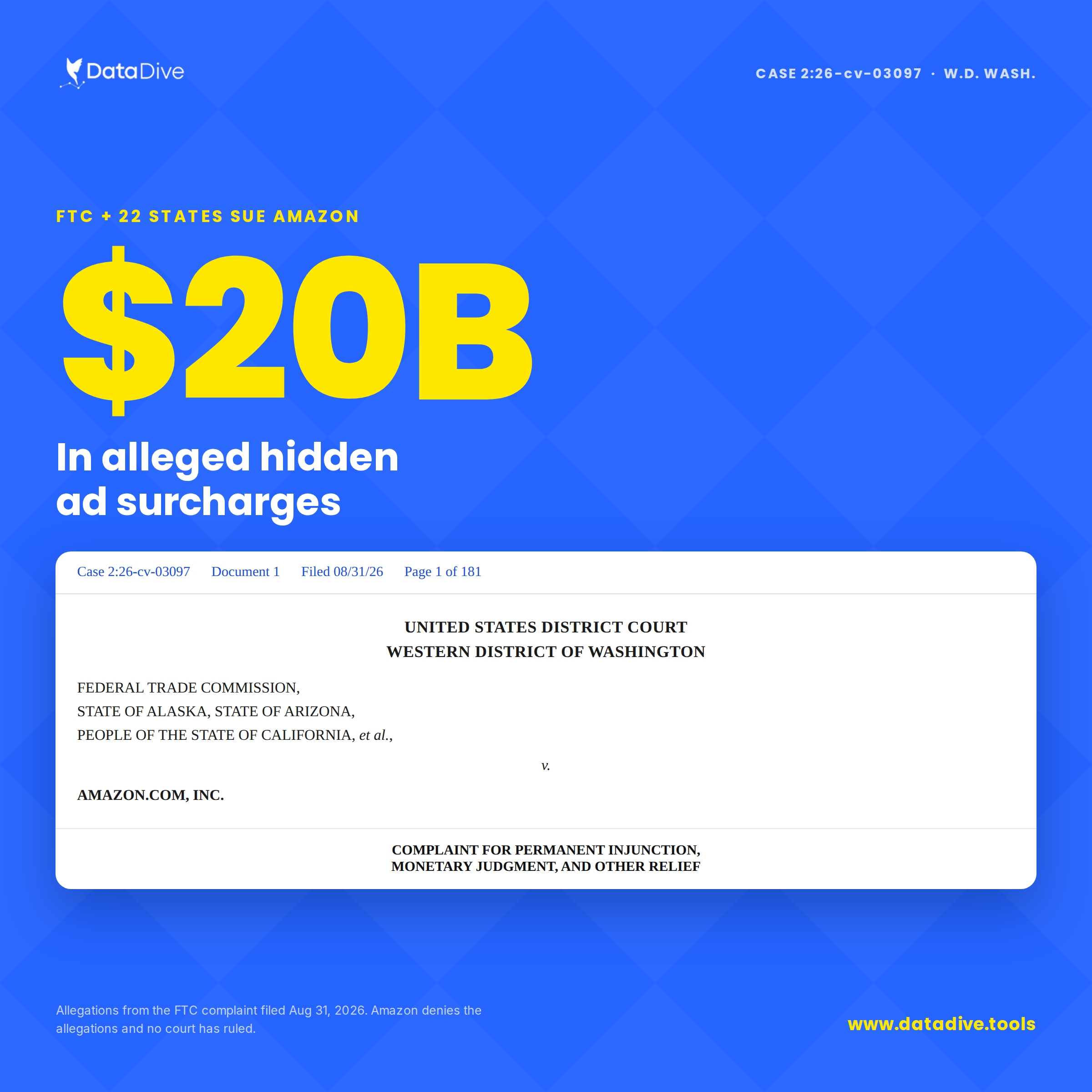
The FTC and 22 states allege Amazon hid surcharges in its advertising auctions for seven years. Amazon denies it. What the complaint says, and what Amazon sellers should do about it.