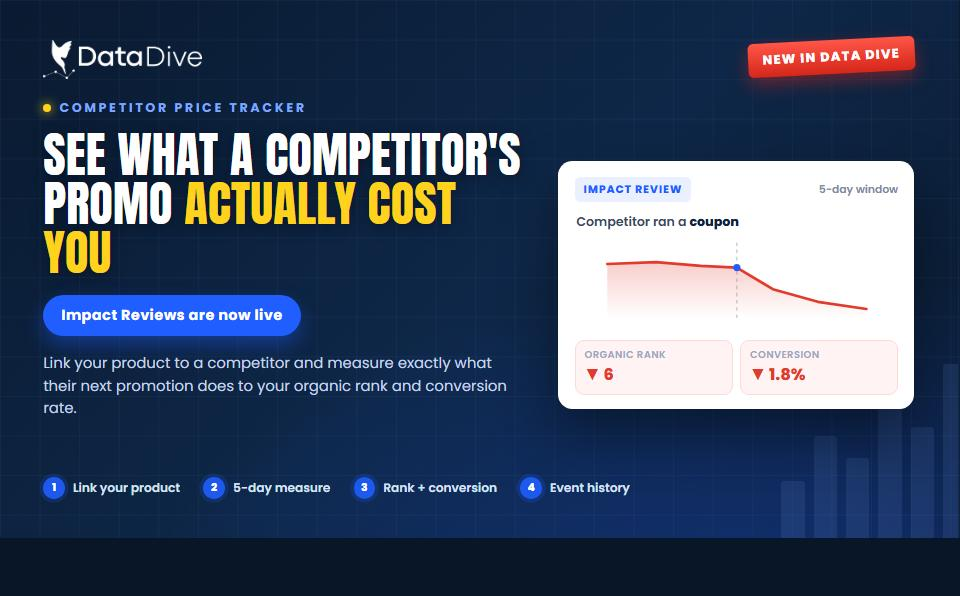
Data Dive’s Competitor Price Tracker Now Gives Impact Review What a Competitor’s Promo Actually Cost You
Your rank slipped last Tuesday. Was that something you did, or something a competitor did? Until now, Competitor Price Tracker could tell

Scaling on Amazon today requires a different operating model than what worked when catalogs were smaller and competition was lighter. Sellers who rely on logging into dashboards, exporting CSV files, and manually checking competitors eventually hit a ceiling. Growth slows once progress depends on constant human attention.
Sellers who continue growing build systems that run continuously. Product research, ranking visibility, and competitor intelligence operate in the background instead of demanding daily manual effort. This approach allows teams to expand without increasing operational strain.
The Data Dive API supports this stage of growth by allowing product research, keyword intelligence, competitor data, and rank tracking to integrate directly into existing tools and workflows.
Manual workflows introduce friction as complexity increases. Checking rankings, reviewing competitors, and compiling reports take longer as catalogs expand and markets become more competitive.
As sellers manage more niches or multiple brands, research tasks multiply. What once required a few checks now demands hours of repetitive work. Signals arrive late, and decisions happen after problems become visible.
Automation solves this by turning research into a continuous process that runs without constant oversight.

Advanced sellers rarely operate inside one platform. Most rely on spreadsheets, internal dashboards, analytics tools, and planning systems designed around their own processes.
The Data Dive API allows niche data, keyword lists, competitor metrics, and rank history to flow directly into those environments.
Examples of how teams apply this include
• Pulling keyword volume and competitor counts into Google Sheets alongside SKU level inventory data
• Feeding new niche research into Airtable bases organized by brand or client
• Connecting Data Dive metrics into Looker dashboards that combine PPC spend, revenue, and ranking data
Instead of exporting files and manually stitching information together, teams integrate Data Dive into the same systems they already use for operations and reporting.

At scale, manually creating and evaluating niches becomes a bottleneck.
Using the API, sellers automate niche creation based on their own logic and criteria. Research becomes a repeatable process that continuously surfaces new opportunities across categories.
This allows teams to evaluate more markets faster and maintain a steady pipeline without rebuilding research from scratch for every launch.
Competitive environments change constantly. New sellers enter categories. Rankings change. Sales concentration evolves across top listings.
With the Data Dive API, teams fetch competitor data automatically and track how markets develop over time. Instead of checking dashboards occasionally, competitor intelligence becomes an ongoing signal.
A brand protecting market position can schedule daily data pulls that highlight ranking movement and notify the team when new sellers enter key positions. This visibility supports earlier responses in pricing, expansion planning, and defensive actions.
The API allows sellers to fetch niche keywords and competitor rankings across many markets at once. Teams then apply their own scoring systems and filters that align with their strategy.
This becomes especially useful for sellers managing large catalogs or agencies standardizing research across many clients while still allowing flexibility at the account level.
Keyword analysis remains consistent, repeatable, and aligned with how the business operates.
Rank tracking becomes far more valuable when it runs automatically.
With Rank Radar data accessible through the API, teams monitor daily ranking movement across keywords and niches. Alerts trigger only when meaningful changes occur.
Use cases include
• Receiving notifications when a primary keyword drops below a defined position
• Posting automatic updates in team communication tools during seasonal demand periods
• Detecting early momentum changes during launches
Rank tracking supports faster decisions instead of requiring constant manual attention.

When Data Dive rank data combines with PPC performance, sales velocity, inventory levels, or internal forecasts, teams create models that reflect actual operations.
The API allows rank data to feed directly into planning, forecasting, and budgeting systems. Research becomes part of the decision engine guiding the business forward.
For agencies, the API feeds Data Dive data directly into client dashboards and reports. This reduces manual work and improves consistency across accounts.
Client reporting becomes easier to maintain. Insights update automatically and reflect current market conditions without repeated manual input.
Across all use cases, the core value of the API is leverage.
Programmatic access removes repetitive exports, manual checks, and fragmented workflows. As teams grow from managing a few niches to dozens or hundreds, analysis scales without additional operational overhead.
Instead of adapting strategy to a fixed interface, businesses build flexible systems around Data Dive that expand alongside them.
Scaling Amazon operations requires systems that connect research, ranking visibility, competitor intelligence, and decision making.
The Data Dive API integrates high quality data into existing workflows, automates tasks that once required daily effort, and supports long term growth without friction.
As competition increases and operations become more complex, advantage belongs to teams that systematize insight and build repeatable processes.
Access to the API requires a Standard or Enterprise Data Dive subscription.
Once available, teams can
Visit the documentation at https://developer.datadive.tools/docs
Generate an API key at https://2.datadive.tools/api-key

Manual workflows eventually limit growth.
Teams that automate research, ranking, and competitor monitoring build systems that scale with them.
Every successful Amazon operation reaches a point where automation becomes essential.
When research, rankings, and competitor intelligence depend on manual effort, growth slows. When those inputs operate continuously through connected systems, teams respond earlier and operate with greater control.
The Data Dive API supports this progression by connecting critical market data into the tools teams already use, removing repetitive work, and enabling infrastructure that expands with the business.
Scaling today belongs to sellers who build systems that last.
Your rank slipped last Tuesday. Was that something you did, or something a competitor did? Until now, Competitor Price Tracker could tell

Amazon caps product titles at 75 characters on July 27, 2026. Here’s the full change, why it matters, and the step-by-step fix using Data Dive.