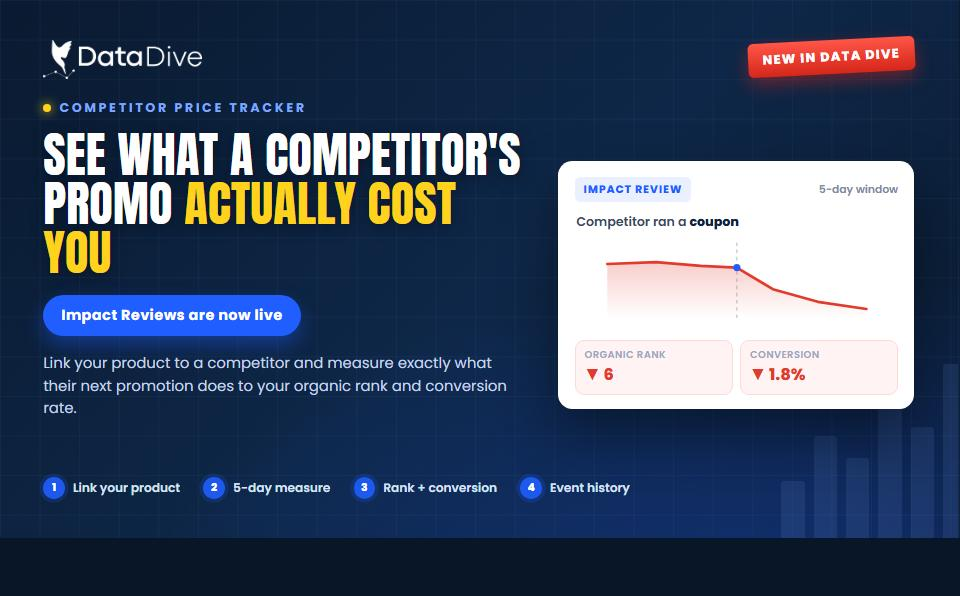
Data Dive’s Competitor Price Tracker Now Gives Impact Review What a Competitor’s Promo Actually Cost You
Your rank slipped last Tuesday. Was that something you did, or something a competitor did? Until now, Competitor Price Tracker could tell
Amazon Rufus and Amazon Cosmo are AI systems Amazon uses to change how shoppers discover and evaluate products. Together, they represent a shift away from traditional keyword matching toward intent-driven and conversational search.
Cosmo operates in the background as part of Amazon’s search and relevance infrastructure. Rufus is the customer-facing AI assistant that helps shoppers ask questions, compare products, and make decisions. Understanding how these systems work is now essential for Amazon fba sellers who want consistent organic visibility.
 | Amazon Rufus is a generative AI shopping assistant embedded in the Amazon Shopping app. It allows shoppers to ask natural language questions instead of typing keywords and scrolling through results. Shoppers use Rufus to understand whether a product fits their needs, how it compares to alternatives, and what tradeoffs exist. Rufus generates responses using Amazon’s product catalog, reviews, Q and A content, and structured listing data. For sellers, Rufus changes how listings are surfaced and recommended. Products that are easier to explain are easier for Rufus to suggest.hat the product does or who it is for, Rufus is less likely to surface it as a recommendation. With Rufus, customers can: Get help comparing product categories, find the best recommendations, or ask questions about a specific product while on a product detail page. |
Rufus evaluates listings based on clarity and explainability. It looks at whether a product’s purpose, use case, and limitations are clearly communicated across images, attributes, and written content.
Listings that perform well with Rufus tend to show the product in use, describe who it is for, and answer common buyer questions without ambiguity. Listings that rely on vague language or inconsistent visuals are harder for Rufus to summarize accurately.
Amazon Cosmo is an AI-driven relevance system that determines which products are eligible to appear for a given search or shopping need. Its purpose is to understand what a shopper is trying to accomplish and rank products that best satisfy that intent.
Unlike traditional keyword matching, Cosmo evaluates meaning. It uses machine learning models and knowledge graphs to connect queries to outcomes. This allows Amazon to rank products based on context, use case, and relevance rather than exact word matches.
For sellers, Cosmo influences indexing depth and ranking breadth. A listing may convert well on ads but still struggle organically if Cosmo cannot confidently associate it with a broader set of related searches. This is often caused by missing keyword roots, limited variant coverage, or weak contextual signals in the listing.
 | Before Cosmo, optimization often focused on repeating primary keywords and driving sales velocity. With Cosmo, ranking depends more on whether a listing represents an entire category of intent rather than a single phrase. This means listings that only target one or two keywords often rank narrowly, while listings that cover related use cases, variants, and contexts rank more broadly. Keyword coverage still matters, but it must be structured and supported by content that explains why the product fits those searches. Cosmo rewards completeness and relevance over repetition. |
Cosmo and Rufus serve different roles but operate on the same underlying understanding of intent.
Cosmo determines which products are eligible to appear for a given need by interpreting search signals and ranking relevance. Rufus uses that intelligence to answer questions and recommend products conversationally.
A listing can struggle when:
Listings perform best when keyword structure, content clarity, and visual signals reinforce each other.
Traditional keyword-focused optimization is no longer enough.
AI-driven systems evaluate:
This shifts optimization toward intent-driven content, structured keyword coverage, and clear explanation rather than keyword density alone.
Data Dive helps sellers understand how broadly their listings are indexed and where keyword gaps exist. It shows which keyword roots drive visibility and which areas competitors dominate.
This allows sellers to expand coverage deliberately rather than rewriting listings blindly. By identifying missing roots and variants, sellers can strengthen Cosmo indexing without disrupting existing rankings.By expanding coverage deliberately, sellers strengthen Cosmo indexing without relying on guesswork.
 | Data Dive’s AI Copywriter works hand in hand with Amazon Rufus. It helps sellers create listing content that explains products clearly while incorporating relevant keywords. Because the copy is grounded in keyword and market data, it supports clarity without sacrificing relevance. This makes it easier for Rufus to interpret what the product does, who it is for, and when it should be recommended.The copy is grounded in keyword data so clarity and relevance improve together. |
Amazon search is becoming AI-native. Products are no longer ranked only on keyword presence but on how well they match shopper intent and how clearly they can be explained by AI systems.
Sellers who focus only on ads or keyword stuffing lose visibility as Rufus and Cosmo reshape discovery. Sellers who align keyword coverage with clear, intent-driven content gain stability and reach.
Amazon Rufus and Cosmo represent a shift toward AI-driven search and discovery. Cosmo determines relevance and ranking eligibility. Rufus interprets listings for conversational recommendations. Both depend on clarity, structure, and intent alignment.
Data Dive helps sellers see where keyword coverage is incomplete, where clarity can improve, and how to optimize safely. When listings are built for both AI interpretation and human understanding, visibility becomes more durable and less dependent on paid traffic.
Your rank slipped last Tuesday. Was that something you did, or something a competitor did? Until now, Competitor Price Tracker could tell

Amazon caps product titles at 75 characters on July 27, 2026. Here’s the full change, why it matters, and the step-by-step fix using Data Dive.