Launching on Amazon today means building a system that connects product discovery, keyword behavior, listing architecture, and inventory planning into one continuous loop. Sellers who treat these steps as separate tasks often see early traction disappear after the first reorder. Sellers who connect them build portfolios that grow.
This framework comes from Brandon Young, CEO of Seller Systems and founder of Data Dive, who has sold on Amazon since 2015 and now operates private label brands producing over $20 million annually. He has taught more than 20,000 entrepreneurs how to approach product research with discipline.
Market discovery begins by studying how demand distributes across a category. Sellers review how many competitors generate daily sales, how many listings operate with deep variation sets, and whether volume spreads across several sellers or concentrates around a single SKU.
Flameless candles illustrate this dynamic. Leading sellers operate between 8 and 26 variations and generate over 100 sales per day, revealing many buyer preferences across colors, pack sizes, and use cases. Seasonality patterns such as holidays, Mother’s Day, Prime Day, and summer add further demand cycles that support steady revenue.
Is Amazon Still Profitable?
Yes Amazon can be incredibly profitable. Amazon profitability now depends on contribution math, inventory velocity, and how many keyword routes a product captures.
Brandon sets $100 per day in net profit as the baseline. At $500,000 in yearly revenue with a 20 percent margin, sellers reach six figure income. He also highlights that a single product producing $250 per day rarely changes life. Replicating that performance across several products produces meaningful income.
How Does Amazon Rank Products?
Amazon ranking uses AI systems Cosmo and Rufus that interpret buyer behavior, product features, benefits, and use cases.
Ranking credit flows through keyword roots. A single conversion on a root phrase spreads influence across hundreds of related long tail phrases when listings contain strong root coverage. Brandon explains this through the golf glove example. The white hero listing attracts generic demand. Pink and black variations convert high intent phrases such as pink golf glove for women. These conversions reinforce the hero listing and extend organic coverage across the category.
This structure explains why listing architecture influences ranking depth far beyond individual keyword placement.
What Is A Master Keyword List?
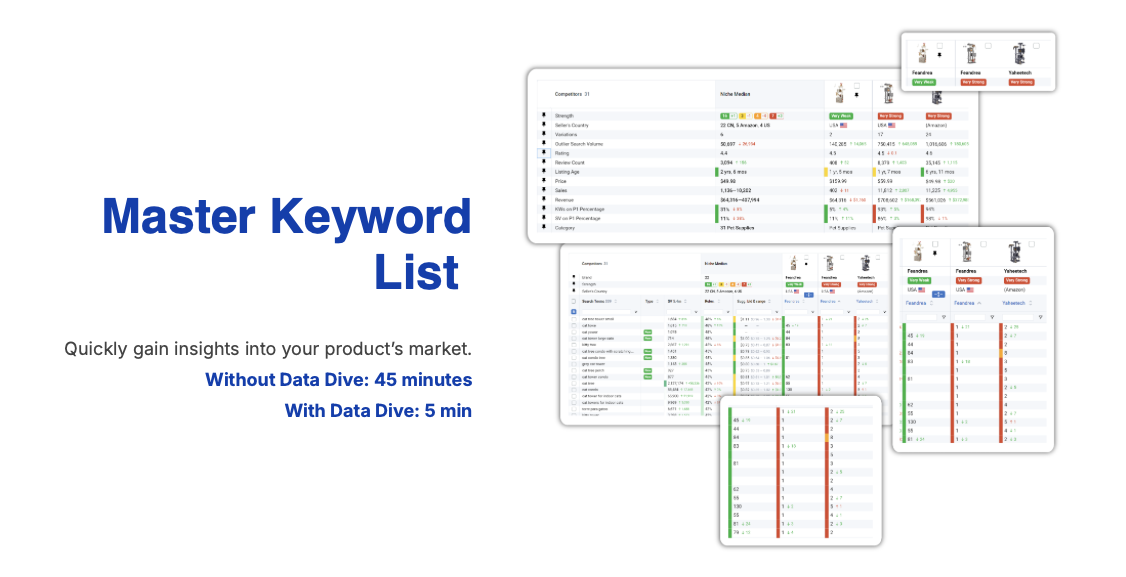
A Master Keyword List is the complete set of keywords that actively generate sales inside a niche, filtered to roughly 30 percent relevancy and at least 400 to 450 monthly searches.
It reveals root phrases such as toiletry bag, shaving bag, dopp kit, and bathroom bag and exposes where competitors dominate or where demand gaps appear. Brandon explains that when ten or fifteen competitors all rank on page one for a phrase, relevance is confirmed. When only one or two sellers rank, opportunity exists.
Sellers use the Master Keyword List to • Identify buyer language across the category • Measure how many competitors dominate each root phrase • Compare indexing breadth between listings • Detect under covered search routes that support expansion
Why Do Products Fail?
Most product failures begin long before launch.
Running out of inventory for over 30 days erases ranking progress and often forces relaunch. A $9,000 inventory estimate often grows toward $18,000 once ads, reorder overlap, and reserve capital appear. Storage fees, returns, and shipping quietly erode margins.
Products built around narrow keyword routes struggle to maintain reorder velocity. Brandon uses the orange golf glove example, where only 170 buyers search each month, far below profit targets. He also highlights IP risks such as Tiffany Blue usage and category risk inside electronics, supplements, and skin care where factory controlled brands dominate.
How Does Data Dive Help?
Data Dive supplies structured visibility across product discovery, keyword routes, listing coverage, and inventory modeling.
Use Data Dive to • Pull Master Keyword Lists across competitors and review every keyword driving sales • Identify root phrases that define buyer behavior • Measure how many competitors dominate each route • Review seasonality patterns including holiday spikes, Prime Day lift, and summer demand • Evaluate whether a product supports $100 per day in contribution profit
How do I Start With Data Dive
It’s incredibly easy to start finding relevant Keyword and competitor info with Data Dive. You can start researching your next product idea within 5 minutes!
Start by signing up for your account and choosing your subscription.
Next simply follow the prompts to run your first Dive. The color coded system makes it easy to interpret the data and make sound decisions that lead to profitable Amazon sales.
Launching on Amazon today works when every stage feeds the next.
Market discovery identifies categories that sustain demand across seasons. Keyword route analysis reveals how buyers describe those categories and how far expansion can run. Listing architecture governs how Amazon distributes ranking credit across those routes. Inventory planning protects momentum through reorder cycles so early traction compounds across the portfolio.
When any of these stages weakens, the entire system breaks. Sellers choose narrow categories, build listings without route depth, or order inventory without modeling reorder velocity. The result appears as lost ranking, stalled sales, and capital trapped in storage fees.
Data Dive brings this system back together. It connects market discovery with keyword mapping, listing coverage, seasonality behavior, and contribution math before capital ever leaves the account. Every successful Amazon portfolio follows this same loop again and again, product by product, year after year.
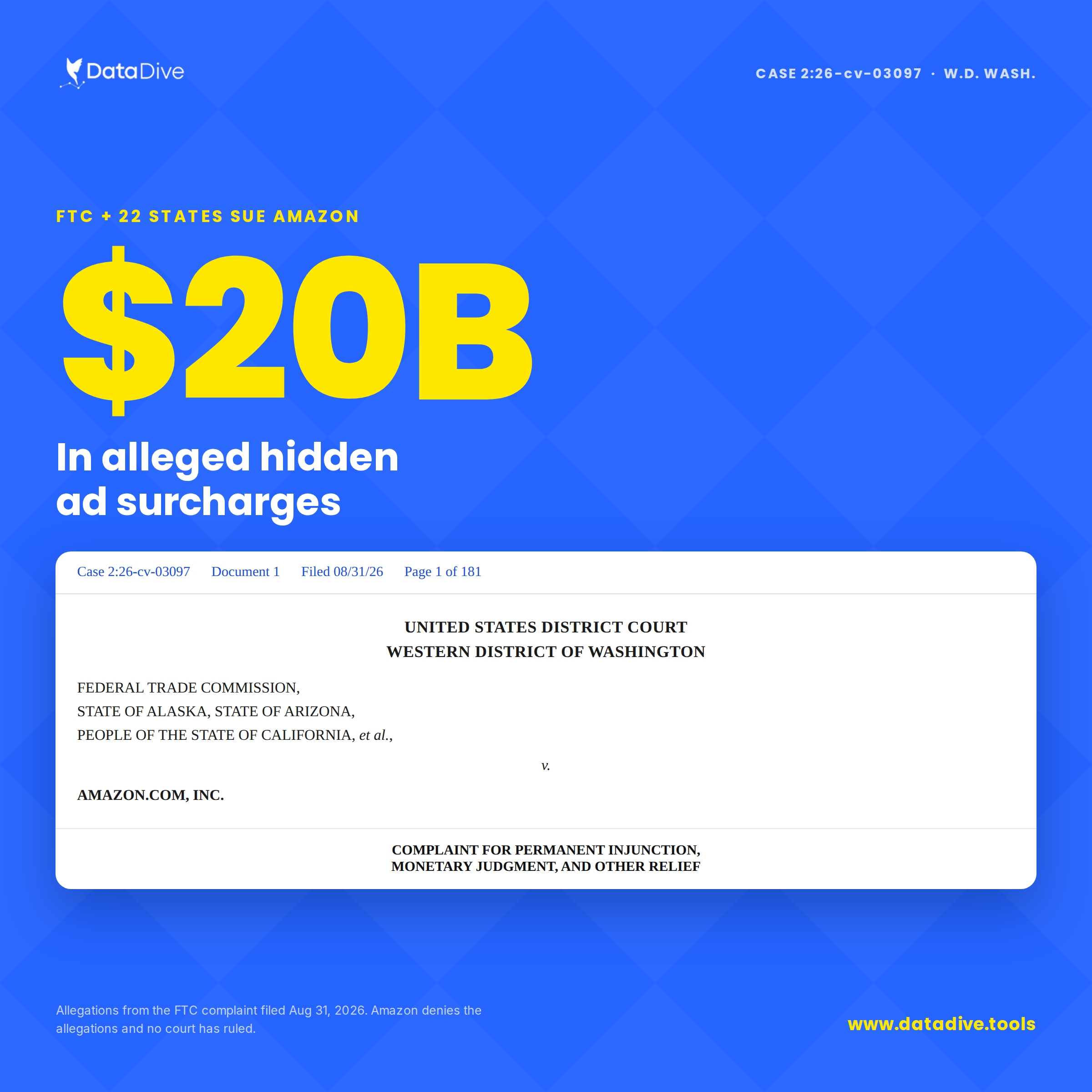
The FTC and 22 states allege Amazon hid surcharges in its advertising auctions for seven years. Amazon denies it. What the complaint says, and what Amazon sellers should do about it.