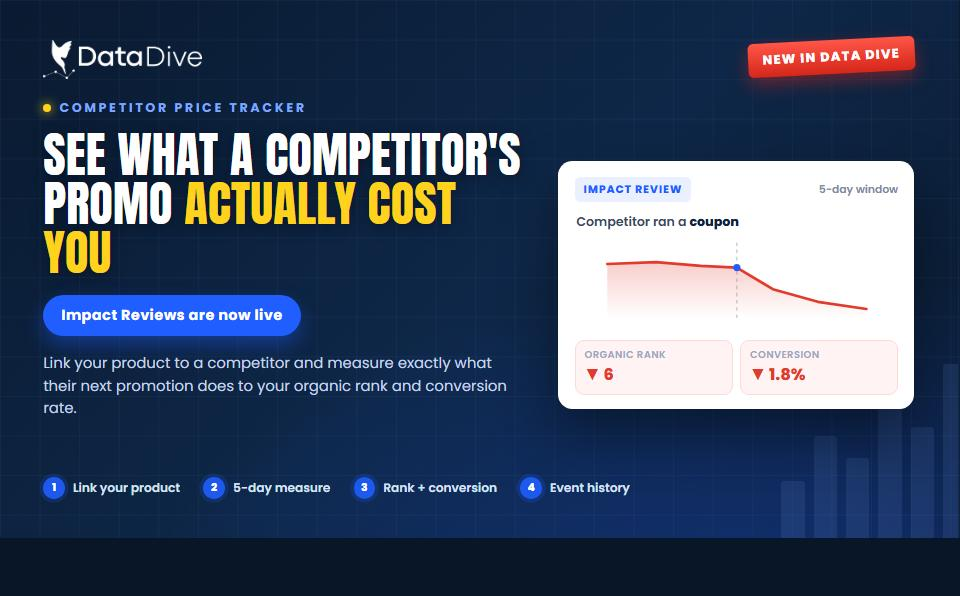
Data Dive’s Competitor Price Tracker Now Gives Impact Review What a Competitor’s Promo Actually Cost You
Your rank slipped last Tuesday. Was that something you did, or something a competitor did? Until now, Competitor Price Tracker could tell

Data Dive Inventory Management MVP Beta is LIVE!
Inventory affects far more than fulfillment. Stock levels influence conversion behavior, delivery expectations, and organic ranking stability. When inventory drops too low or delivery times extend, performance can decline quickly.
Many sellers discover these problems too late because inventory information lives in separate places. Stock levels sit inside Seller Central, performance insights sit inside analytics tools, and ranking insights appear somewhere else.
Data Dive Inventory Management changes that workflow by placing inventory context directly alongside product performance.
The result is faster detection of risk and quicker operational decisions.
Inventory shortages can influence multiple parts of listing performance.
When availability drops or delivery timelines extend, customers may hesitate to purchase. Conversion rates often decline when buyers see longer shipping windows. As conversion weakens, listing momentum can slow and organic visibility may decrease.
This creates a chain reaction. Reduced visibility leads to fewer sales. Fewer sales reduce sell-through velocity. The listing begins to lose momentum.
Monitoring inventory earlier helps prevent this sequence.
When sellers can identify inventory risks before stock runs out, they can prioritize restocking and maintain consistent performance.

Many sellers monitor inventory using several different tools.
Stock levels often live in Seller Central. Sales performance appears in separate analytics dashboards. Keyword and ranking data are tracked elsewhere.
Switching between these systems slows decision-making and hides relationships between inventory levels and product performance.
Manual tracking also increases the chance that stock risks go unnoticed until sales have already declined.
Inventory monitoring becomes much more effective when operational signals appear in one environment.
Data Dive Inventory Management integrates inventory visibility directly into the Product Catalog view.
This allows sellers to see inventory data next to product performance metrics inside the same dashboard.
Inside the Catalog view, sellers can track stock levels across locations and observe shipping timelines connected to those inventory levels. This provides context for how delivery expectations may influence buyer behavior.
Instead of checking inventory separately, sellers can evaluate inventory conditions at the same time they review sales activity.
This integration helps identify stockout risks earlier.
When inventory signals appear alongside performance data, sellers gain stronger operational awareness.
They can immediately see which products approach stock depletion and prioritize restocking accordingly. This prevents best-selling listings from losing momentum due to inventory gaps.
Inventory context also helps maintain listing stability. Consistent availability supports stronger conversion behavior and protects organic ranking.
By connecting stock levels with performance insights, sellers can make more informed decisions about replenishment and inventory planning.

The Inventory Management MVP Beta is available to all Standard and Enterprise Data Dive users.
Once enabled, inventory insights appear directly inside the Product Catalog environment. Sellers can monitor stock levels and shipping timelines without switching between platforms.
This unified view simplifies inventory oversight and reduces the need for manual monitoring across multiple systems.
The current beta introduces the foundation for deeper inventory intelligence.
Future updates will include refill recommendations that help identify which products should be restocked first based on performance signals.
Additional alerts will notify sellers when delivery timelines risk impacting customer experience.
Integration with feeder warehouses is also planned. Many sellers store inventory outside Amazon due to cost considerations, and these integrations will allow visibility across those external storage locations as well.
These improvements will expand inventory monitoring into a broader operational system.
Your rank slipped last Tuesday. Was that something you did, or something a competitor did? Until now, Competitor Price Tracker could tell

Amazon caps product titles at 75 characters on July 27, 2026. Here’s the full change, why it matters, and the step-by-step fix using Data Dive.