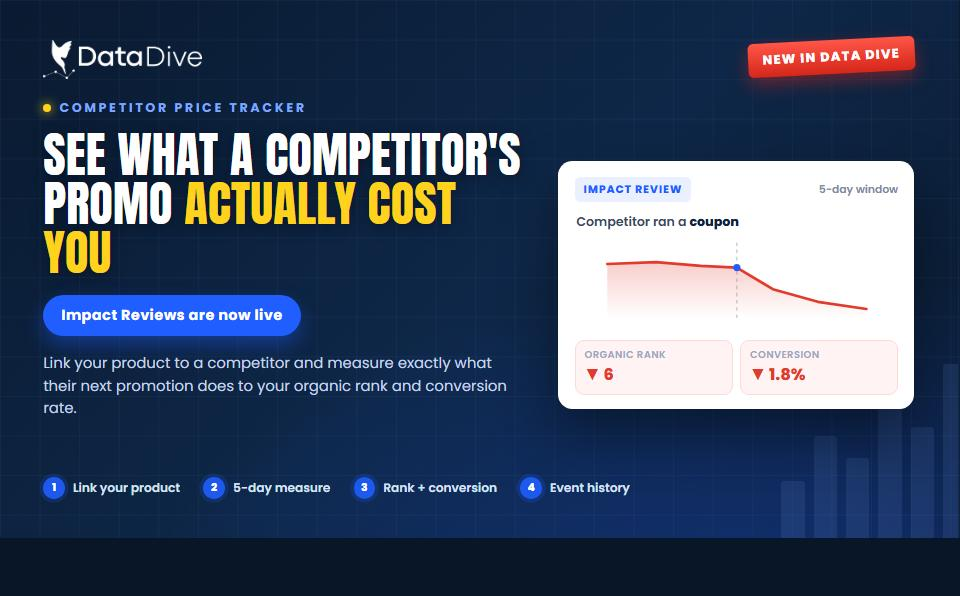
Data Dive’s Competitor Price Tracker Now Gives Impact Review What a Competitor’s Promo Actually Cost You
Your rank slipped last Tuesday. Was that something you did, or something a competitor did? Until now, Competitor Price Tracker could tell

Amazon deal days can drive a large volume of traffic, but most sellers lose margin because they follow default structures without understanding how deals actually work.
The opportunity comes from knowing how Amazon structures its deal windows, how discounts are enforced, and how timing affects both visibility and profitability.
When used correctly, deals can generate strong sales without sacrificing unnecessary margin.
This approach focuses on controlling when discounts run, meeting eligibility requirements early, and aligning promotions with buyer behavior.
Amazon deals provide several scheduling options, each with the same fee but very different outcomes.
Sellers can choose a Black Friday window with a lead-in period, a weekend through Cyber Monday window, or a full 12-day event.
The cost remains the same across these options, but the requirement to discount products across the entire selected window can impact profitability.
The full 12-day option is where most sellers lose control. Running discounts for that entire duration reduces margins before peak buying days even begin.
Understanding how scheduling works is the first step toward protecting profit.
Amazon deals allow sellers to submit Prime Exclusive Discounts up to 12 hours before the event ends.
This creates a window of flexibility that many sellers overlook.
Sellers can select the full event window but delay activating the discount until the most important days, such as Thanksgiving, Black Friday, or the days leading into Cyber Monday.
This allows sellers to focus their discounts only when traffic and purchase intent are highest.
If the deal is rejected due to pricing or eligibility issues, there may not be enough time to fix it.
To reduce this risk, it is better to prepare and submit a few days earlier while still controlling when the discount becomes active.

An Amazon deal cannot be paused and restarted once live. If a seller wants to split promotions across different days, each group requires its own fee.
There are also strict requirements around pricing. Amazon deals are often rejected due to missing list prices or incorrect reference pricing.
To prepare:
This process can take a couple of days, so it should be handled before deal submission.
Planning ahead prevents last-minute issues that could block your promotion.
Prime Exclusive Discounts must meet several conditions.
The discount must be at least 20 percent off the current or sale price.
It must also be at least 5 percent below the non-Prime price and 15 percent below the reference price.
In addition, the deal price must be lower than both the 90-day and 30-day price median.
Seller and product quality also affect eligibility.
Seller feedback must remain above 3.5, and product ratings should stay above 4 stars.
Listings that fall below these thresholds may need to rely on alternative promotions such as coupons.
These requirements determine whether a deal is approved and how visible it becomes during peak shopping periods.
Cart abandoner promotions rely on a snapshot of shopper activity from the previous 90 days.
The timing of this snapshot is critical.
If the promotion is set up too early, it may miss recent shoppers who showed interest during the peak period.
If it is set up too late, it may not capture the full audience before deal days begin.
Setting up these promotions shortly before Black Friday or just before Cyber Monday allows sellers to target recent high-intent shoppers.
Because the snapshot takes time to process and updates weekly, timing directly influences how effective the promotion will be.

Profit comes from control.
Controlling when discounts run prevents unnecessary margin loss. Preparing pricing and eligibility in advance avoids rejected deals.
Aligning promotions with buyer behavior increases the chance of conversion during peak demand.
Instead of spreading discounts across long timeframes, focus on the days where buying intent is strongest.
This keeps margins intact while still capturing high traffic periods.
Deals should support performance, not erode it.
Maximizing profits during Amazon deal days depends on understanding how timing, pricing, and eligibility work together.
Selecting the right deal window gives flexibility.
Delaying discount activation helps avoid unnecessary margin loss.
Preparing pricing requirements in advance ensures deals are approved without delays.
Timing promotions correctly allows sellers to reach buyers when purchase intent is highest.
Each decision connects back to one goal, which is maintaining control over when and how discounts are applied.
Sellers who approach deal days with this level of structure can capture high sales volume while protecting profitability and sustaining long-term performance.
These improvements will expand inventory monitoring into a broader operational system.
Your rank slipped last Tuesday. Was that something you did, or something a competitor did? Until now, Competitor Price Tracker could tell

Amazon caps product titles at 75 characters on July 27, 2026. Here’s the full change, why it matters, and the step-by-step fix using Data Dive.