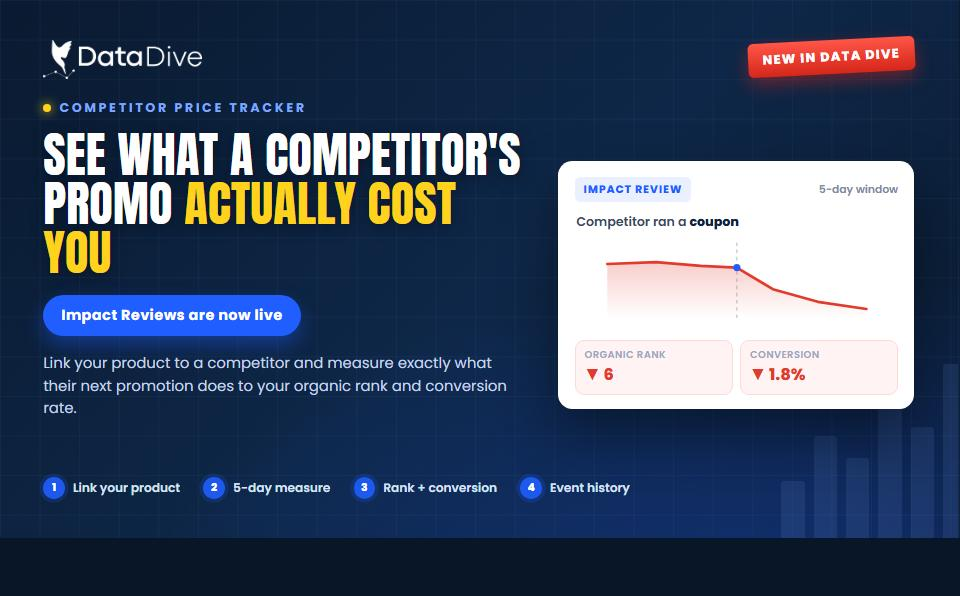
Data Dive’s Competitor Price Tracker Now Gives Impact Review What a Competitor’s Promo Actually Cost You
Your rank slipped last Tuesday. Was that something you did, or something a competitor did? Until now, Competitor Price Tracker could tell
Amazon Haul Beta is a low price mobile shopping channel inside the Amazon app, where products priced under $20 are promoted through a discovery driven feed. Inventory originates mainly from factories outside the US, with Amazon controlling sourcing, fulfillment structure, pricing exposure, and promotion placement.
Amazon Haul is a strategic response to the success of platforms like Temu and Shein that focus on cheap products sold at significant volume.
For Amazon fba sellers, this creates new pressure on conversion, pricing power, and traffic flow. For sellers using Data Dive, it also produces measurable signals that guide pricing and positioning decisions before revenue damage becomes visible.
| Amazon Haul Beta functions as a discovery feed inside the Amazon mobile app where shoppers scroll through short product videos and visual product cards, then purchase without leaving the feed. All items remain under $20, with many starting at $2.99 and periodic flash pricing dropping to cents. Most inventory ships from outside the US, primarily China. Amazon manages customs and lists the buyer as the importer. Orders under $25 carry a $3.99 shipping fee, no Prime eligibility, delivery windows up to 14 days, and a 15 day return period for items above $3. |  |
Third party sellers currently do not list inside Haul. Amazon sources products directly from manufacturers and controls pricing, merchandising, and promotion. Haul receives premium mobile placement through banners, in app promotions, and push notifications. This diverts visibility away from standard listings in fashion, beauty, accessories, gadgets, and low ticket home categories.
Inside Data Dive, sellers can identify this exposure immediately by running Niche Dive on Haul targeted categories. Master Keyword List reveals where buyer intent begins aligning with ultra low price search behavior.
 | Haul establishes a new reference point for perceived value. When shoppers consistently see $3 cosmetics and $5 phone accessories, higher priced private label offers encounter stronger conversion resistance. Delivery speed and Prime eligibility lose part of their influence when price takes priority. This environment produces visible data impacts across seller accounts. Conversion softness appears first in low ticket FBA products. Buy Box pressure increases as repricing frequency rises. PPC costs push upward as multiple sellers defend shrinking attention bands. Data Dive quantifies these movements early. Niche Dive shows penetration by category. Master Keyword List isolates bargain driven intent. Rank Radar displays organic position and share of voice movement before ranking losses spread across the catalog. Sellers who observe these changes at the keyword and category level retain control of offer strategy rather than reacting to payout declines weeks later. |
| In a compressed pricing environment, sellers require immediate clarity across traffic, margin, and demand. Data Dive delivers that clarity through integrated research, modeling, and rank tracking. Running Niche Dive across a catalog separates SKUs exposed to budget competition from products supported by review depth and brand strength. Profit modeling allows sellers to test price reductions from 10% to 25% alongside rising ad costs. SKUs that fall below acceptable margin thresholds under these conditions signal sourcing adjustments, repositioning, or removal from reorder cycles. Review Analysis and AI Product Brief tools reveal why shoppers purchase beyond price alone. These insights guide bundle creation, packaging upgrades, content refinement, and branded positioning that protect pricing leverage. Rank Radar and keyword tracking reveal when buyer traffic gravitates toward low cost alternatives shaped by Haul behavior. Sellers respond by aligning listing copy, media, and offer structure as ranking movement occurs. Haul remains visible within the same dashboard where ads, listings, keywords, and profit already operate, allowing planning without delay. |  |
Amazon introduced Haul following import rule changes in 2025 that weakened Temu and Shein within the US. Amazon then accelerated expansion of the Haul model globally under the Amazon Bazaar name across 14 markets.
Access to Haul remains closed to sellers today, yet a hybrid participation model remains likely within 12 months. Third party sellers generate over 60% of total platform revenue, and Amazon cannot source every low ticket SKU at scale indefinitely.
If participation opens, sellers with factory relationships and excess inventory gain a controlled liquidation channel. Data Dive enables rapid SKU screening, price anchoring analysis, and margin protection before inventory enters such a channel. At the same time, premium positioned sellers continue to benefit from Prime delivery, review authority, brand loyalty, and upsell structure that ultra low price channels cannot replicate.
Amazon Haul Beta reflects continued movement toward mobile discovery and value driven commerce. Sellers who use Haul behavior as a live data source preserve pricing control and strategic flexibility as the marketplace evolves.
Amazon Haul Beta introduces a structural change inside the Amazon mobile ecosystem that prioritizes ultra low pricing and discovery driven shopping. This affects pricing anchors, traffic distribution, and category economics across the broader marketplace. Sellers who rely solely on entry level pricing face rising pressure. Sellers who operate with accurate data, differentiated offers, and margin visibility retain control.
Data Dive equips sellers with category intelligence, keyword movement, pricing stress tests, and buyer motivation analysis required to interpret Haul activity before it reshapes revenue performance. In an environment driven by value discovery, early data visibility determines long term stability.
Your rank slipped last Tuesday. Was that something you did, or something a competitor did? Until now, Competitor Price Tracker could tell

Amazon caps product titles at 75 characters on July 27, 2026. Here’s the full change, why it matters, and the step-by-step fix using Data Dive.