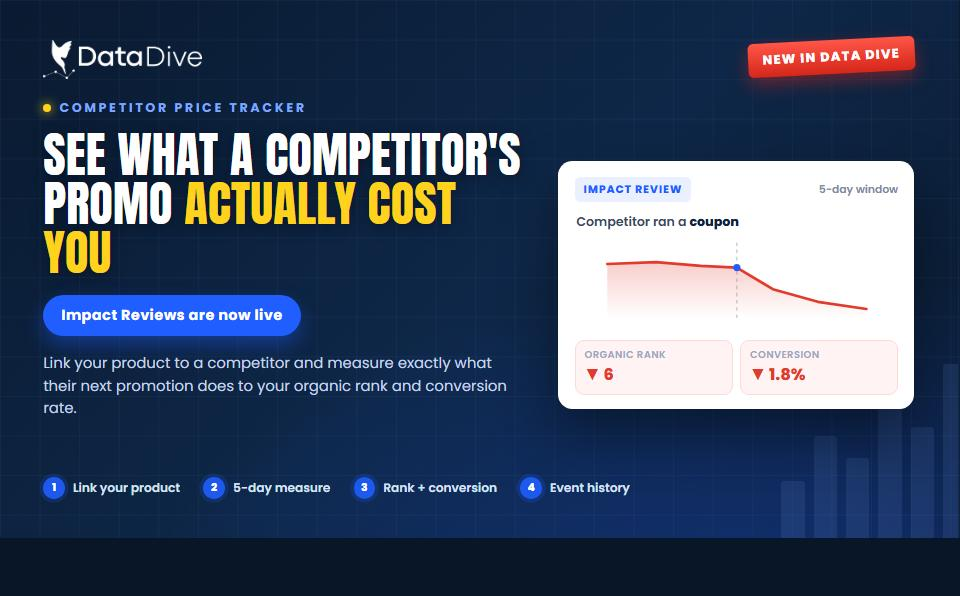
Data Dive’s Competitor Price Tracker Now Gives Impact Review What a Competitor’s Promo Actually Cost You
Your rank slipped last Tuesday. Was that something you did, or something a competitor did? Until now, Competitor Price Tracker could tell

Finding a product to sell on Amazon starts with one simple but critical question. How are current sellers getting their sales?
Most people approach product selection by looking for ideas. They scroll through listings, look at trending products, or copy what appears popular.
The problem with this approach is that it ignores how Amazon actually works. Amazon is driven by search behavior.
Customers type in specific keywords or serp term, and the platform rewards listings that match those searches and convert consistently.
If you do not understand where traffic comes from, you are not making a strategic decision. You are guessing.
The goal is to reverse engineer what is already working. That means understanding how top listings are ranking, which keywords are driving traffic, and how those listings convert that traffic into successful products.
Once you can break that down, you can start identifying where there is room to compete and where there is no realistic opportunity.
This is the difference between randomly picking products and building a system that consistently produces viable opportunities.
The foundation of Amazon product research is competitor and keyword analysis.
Every successful product is supported by a set of keywords that bring in traffic. Those keywords represent real customer intent.
If you understand which keywords drives traffic, you understand the engine behind the product.
This is where Data Dive becomes valuable. It allows you to take multiple competing listings and break them down into a structured view.
You can see how each product ranks across a large set of keywords, which gives you a clear picture of how they are generating visibility.
Instead of looking at a listing and assuming it is successful, you can see exactly why it is successful.
You may find that some competitors rank strongly across high-volume keywords. That usually indicates a more competitive environment where entering will require significant effort and resources.
In other cases, you may find gaps. An Amazon product might be performing well overall but has weak coverage across certain keywords.
This type of analysis allows you to evaluate opportunity with more precision. It also helps you identify weak execution.
Some products perform well because competition is low, not because they are optimized.
When you spot that, it becomes easier to see how you could build a stronger listing and capture market share.
Without this level of analysis, you are relying on surface-level observations. With it, you are making decisions based on how traffic and ranking actually work.
Looking at a broad category is one of the most common mistakes in Amazon product research.
A niche is never as simple as it looks. Within any category, there are multiple variations of a product, each serving different customer needs.
These variations form sub niches, and each one behaves differently in terms of demand, pricing, and competition.
Take a product like a whiteboard.
At first glance, it looks like a single category. In reality, it includes multiple variations such as large boards for offices, small boards for personal use, mounted versions, portable versions, and bundles with accessories.
Each of these variations attracts a different type of buyer.
Someone looking for a large board for a conference room has a completely different intent compared to someone looking for a small board for a desk.
That intent shows up in the keywords they search for.
If you only analyze the broad category, you miss these differences. You might assume the entire niche is competitive or unprofitable when, in reality, certain sub niches may offer strong opportunities.
The key is to break the niche down into these segments and analyze them individually.
By doing this, you can identify which sub niches have consistent demand, where competition is weaker, and where pricing allows for a viable margin.
This approach helps you avoid crowded areas and focus your effort on segments where you have a higher probability of success.
Instead of launching a generic Amazon product, you can design and optimize specifically for a defined segment of the market.

Once you identify a potential Amazon product, the next step is evaluating whether it makes sense financially.
The first factor is profit. If you cannot source the product, ship it, and sell it at a price that leaves a healthy margin, the product should be eliminated immediately.
This includes all costs. Manufacturing, shipping, storage, and platform fees all need to be considered.
Large or heavy products can quickly become expensive to fulfill, which reduces profitability even if sales volume looks strong.
The second factor is budget.
Some products require more capital than expected. An Amazon seller might start with a small budget, but certain products require higher inventory levels to compete effectively.
If competitors are selling hundreds of units per month, you need enough inventory to support that level of demand.
If you cannot meet that requirement, you risk running out of stock early or failing to gain traction.
The third factor is risk.
Risk comes from competition, demand stability, and your ability to differentiate.
By analyzing competitors and keyword performance, you can estimate how many units you might realistically sell and how difficult it will be to enter the market.
You can also identify potential challenges early. For example, if a product is dominated by a major seller or even by Amazon itself, that changes the level of competition significantly.
Strong Amazon product selection comes from filtering out weak opportunities.
The goal is not to make every product work. The goal is to identify the few products that meet all the criteria.

One of the biggest misconceptions in Amazon product research is that you will find a strong opportunity quickly. In reality, this is a numbers-driven process. Most Amazon products you evaluate will not be worth pursuing. Some will fail on profit. Others will fail on competition. Some may look promising at first but break down when you analyze them more closely.
It is common to go through dozens of products before finding one that meets all the criteria. In many cases, sellers analyze over a hundred products before identifying a few strong candidates.
This is why having a structured process matters.
When you evaluate each product using the same criteria, you can move through options efficiently without losing consistency. Tools like Data Dive help speed up this process by providing clear insights into keyword performance and competitor positioning.
Each product becomes a quick decision.
You check demand, competition, profit, and feasibility. If it does not meet the standard, you move on. If it does, you take it to the next stage, which might include deeper analysis, supplier research, or sampling.
Over time, this process becomes faster and more intuitive.
The key is to stay consistent and not stop too early.
The more products you analyze, the higher your chances of finding one that stands out.
Finding winning products on Amazon is not about creativity or luck. It is about understanding how the marketplace works and using that understanding to guide decisions.
Competitor and keyword analysis reveal how traffic is generated. Sub niche breakdown helps identify where opportunities exist. Profit, budget, and risk determine whether a product is viable.
Consistent evaluation across many products increases your chances of finding strong opportunities.
Each part of the process builds on the others.
When you follow this approach, product selection becomes structured and repeatable. You are no longer relying on ideas or trends. You are making decisions based on data, clear criteria, and a process that can be applied again and again.
That is what allows sellers to move from uncertainty to consistent results.
Your rank slipped last Tuesday. Was that something you did, or something a competitor did? Until now, Competitor Price Tracker could tell

Amazon caps product titles at 75 characters on July 27, 2026. Here’s the full change, why it matters, and the step-by-step fix using Data Dive.