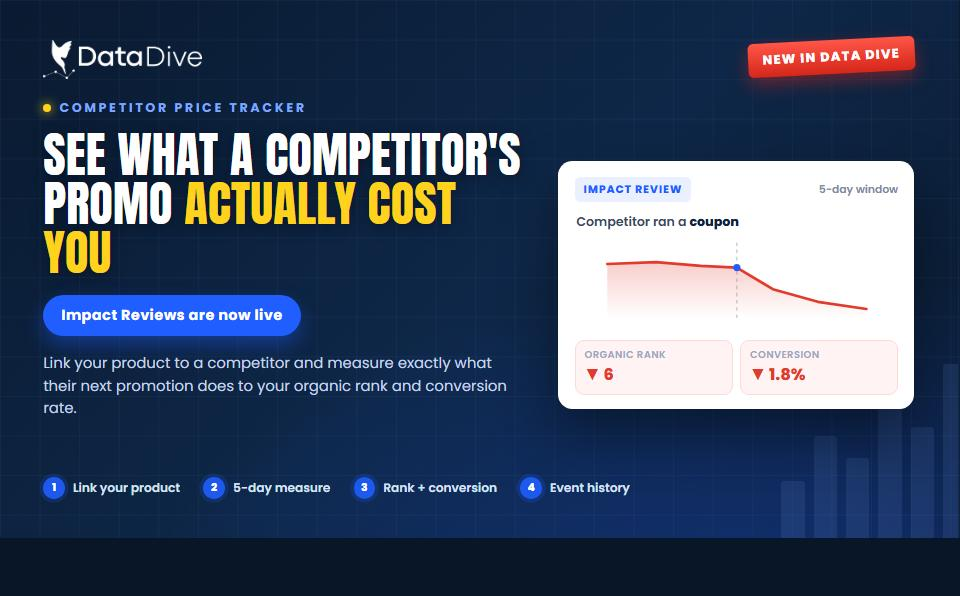
Data Dive’s Competitor Price Tracker Now Gives Impact Review What a Competitor’s Promo Actually Cost You
Your rank slipped last Tuesday. Was that something you did, or something a competitor did? Until now, Competitor Price Tracker could tell

Building an Amazon business without a plan often leads to scattered decisions, inconsistent performance, and wasted effort. Growth comes from knowing what you are trying to achieve, understanding which actions actually move the business forward, and building a structure that allows you to execute consistently.
Most sellers do not struggle because of lack of effort. They struggle because effort is not directed toward the right areas. When planning, execution, and structure are aligned, growth becomes far more predictable.
Everything starts with defining what the Amazon business needs to achieve over a specific period, usually a year.
That goal cannot stay broad. It needs to translate into numbers such as revenue targets, profit targets, and operational benchmarks. These must be clear enough that you can measure progress weekly or even daily.
Once those targets are set, the next step is working backwards.
If the goal is to reach a certain revenue level, you need to break that down into what must happen at the product level:
• How many units need to sell
• What price points are required
• How many products contribute to that total
This is where most sellers fall short. They set a target, but they do not translate it into actions.
There is also a personal layer to this. Founders operate differently. Some focus on ideas and long-term direction, while others focus on execution and systems. Growth requires both. If one is missing, progress slows. If both are present, the business moves forward with more consistency.
Without a structured plan, it becomes easy to chase new ideas, switch direction, or lose momentum.
A clear plan keeps execution grounded in what actually drives results.
Not every action in an Amazon business produces the same outcome.
Some tasks feel productive but do very little to move revenue or profit. Others, when executed correctly, can create a noticeable jump in performance.
These are the levers that matter.
In an Amazon business, the main levers include:
• Pricing
• Conversion rate
• Traffic
• New product launches
• Expansion into additional sales channels
The challenge is deciding which one deserves your attention right now.
For example, improving conversion on an existing product can generate a strong increase in revenue without bringing in more traffic. If a listing converts at a higher rate, every visitor becomes more valuable.
On the other hand, launching new products introduces entirely new revenue streams. A well-executed product launch can outperform small optimizations across existing listings.
The key is not to try everything at once. It is to identify the lever that produces the strongest return based on your current situation. That decision depends on capital, team capacity, and how the business is currently performing.
When the right lever is selected and executed well, growth becomes much easier to achieve.

Every product in an Amazon business depends on two core drivers, traffic and conversion.
Traffic determines how many people land on your listing.
Conversion determines how many of those people actually buy.
It is common to focus on one and overlook the other, which leads to inefficient growth.
If traffic increases but the listing does not convert well, you are paying for attention without turning it into sales. If conversion improves but traffic stays low, the impact remains limited.
The two need to move together. Think of it as visibility and presentation.
A product placed in front of many people but presented poorly will struggle to sell. A product presented well but rarely seen will not generate enough volume.
Improving conversion comes from refining the listing. This includes how the product is positioned, how clearly the value is communicated, and how the offer compares to competitors.
Improving traffic comes from increasing visibility:
• Better ranking (Impression Rate, Click-Through-Rate, Conversion Rate and Sales Velocity)
• Correct keyword coverage
• Additional exposure through PPC ads or other channels
When both are aligned, revenue grows without relying entirely on launching new products.

Structure becomes more important as the business grows.
In the early stage, one person may handle everything. Product research, sourcing, listing creation, marketing, and operations all sit with the same individual. This works up to a certain point.
As revenue increases, this approach starts to break down. The workload expands, decisions slow down, and mistakes become more frequent.
Even at the early stage, it helps to map out the key functions of the business:
• Marketing
• Finance
• Sourcing
• Product development
Each should be treated as a separate responsibility with clear expectations and measurable KPIs.
You can see where performance is strong and where it needs improvement.
As the Amazon business grows, responsibilities change. The founder moves away from handling every task and begins managing people and systems.
This transition is often uncomfortable. Letting go of control feels risky, but holding on to everything limits growth.
At higher levels, teams take ownership of specific functions or product groups. This introduces more complexity.
Without proper training, clear processes, and accountability, that complexity can reduce performance.
Structure allows the business to grow without losing control over execution.
Growing an Amazon business comes down to aligning a few critical elements.
Clear goals define what the business is working toward.
Growth levers determine where effort should be focused. Traffic and conversion drive the performance of existing products. New products expand the overall opportunity. Structure ensures that execution can keep up as the business grows.
Each part connects to the others. Without clear goals, execution loses direction. Without the right levers, effort produces weak results.
Without structure, growth creates problems instead of progress.
As the Amazon business evolves, the role of the founder evolves as well. Moving from doing everything to managing systems and people allows the business to operate at a higher level.
When all of these elements work together, growth becomes steady, controlled, and easier to sustain over time.
Your rank slipped last Tuesday. Was that something you did, or something a competitor did? Until now, Competitor Price Tracker could tell

Amazon caps product titles at 75 characters on July 27, 2026. Here’s the full change, why it matters, and the step-by-step fix using Data Dive.