How to Connect Your Amazon Data to Claude and ChatGPT with the Data Dive MCP
Connect your Data Dive account to Claude or ChatGPT in about a minute. Full setup steps for both, copy-paste prompts, FAQs, and what the MCP can actually do.
I just got back from Amazon Accelerate in Seattle, and I wanted to write this one myself. This year Amazon invited me as a partner. I recorded in their studio, sat in on the sessions, and got an early look at what’s shipping next. I came home more bullish on selling on Amazon than I’ve been in years. Here’s what matters, and what I’m doing about it.
— Brandon Young, CEO, Data Dive

On the floor at Amazon Accelerate 2026 in Seattle.
Amazon Accelerate 2026 took place September 22–24 in Seattle. The three announcements with the most money attached for sellers were: Time to Prime, which shows how long it takes a given customer to receive your item (Amazon shared that going from five-day merchant-fulfilled delivery to two-day Prime lifts conversion rate about 50%, and two-day to same-day adds roughly another 15%); AI auto-optimization for Sponsored Products, which adjusts keyword targeting, product targeting and bids around seasonality and performance (Amazon said campaigns using it got to a first sale 40% faster and saw conversions up to 67% higher); and the confirmation that 16% of third-party seller revenue last year came from new product launches. The through-line: speed, AI and fresh selection are where Amazon is putting its weight, and sellers who line up with that will grow faster.
Different from any Accelerate I’ve attended. This year Amazon invited me as a partner, which meant I recorded in their studio with the Amazon Media Team and got something close to a backstage pass to the features they’re about to roll out.
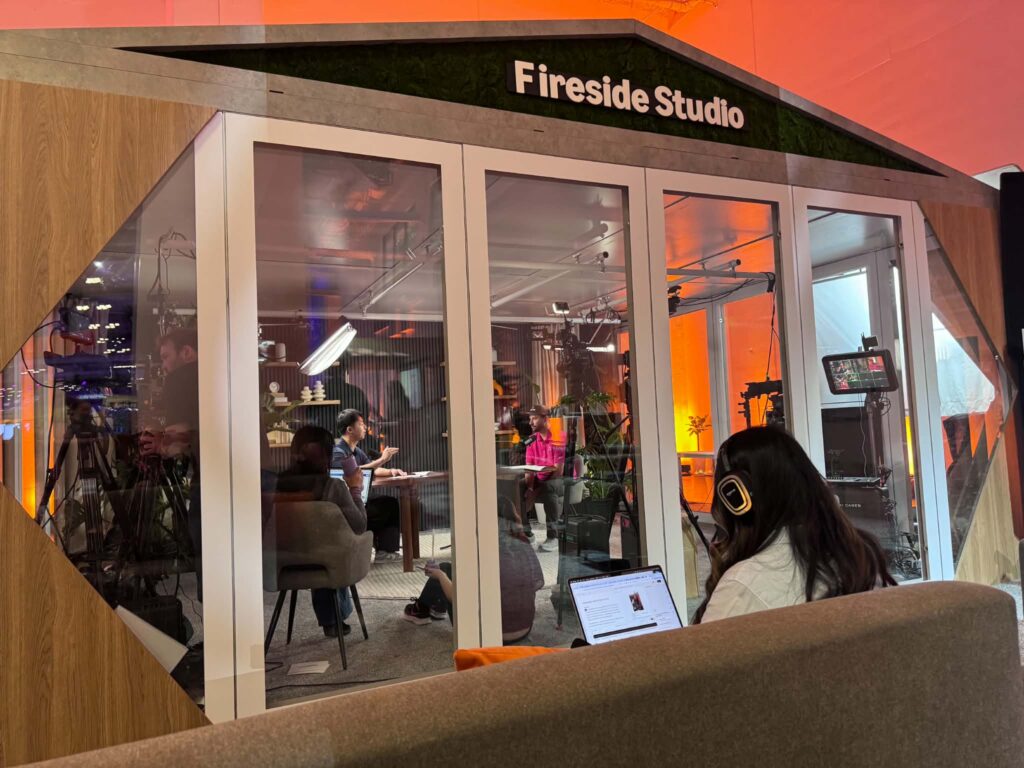
Amazon’s Fireside Studio at Accelerate, where partner interviews were recorded throughout the event.
That context matters, so let me give you a little more of it.
I’m not writing this as a software CEO who watched the keynote. I sell on Amazon every day.
Our brands are on pace for roughly $25 million in Amazon sales this year, and every tool we build at Data Dive gets tested on our own catalog first.
So when I sit in a session and Amazon puts a number on the screen, the first question in my head is always the same: does that match what we’re seeing in our own business?
This year, the answer kept coming back yes. That’s why I’m excited.
Time to Prime shows sellers how long it will take any given customer to receive an item they order.
It turns delivery speed, which most sellers treat as Amazon’s problem, into a number you can see and act on.
Amazon shared that moving from merchant-fulfilled five-day delivery to two-day Prime delivery is worth about a 50% increase in conversion rate.
Going from two-day Prime to same-day adds roughly another 15% lift in conversion rate.
| Delivery move | Conversion rate impact (per Amazon at Accelerate) |
|---|---|
| Merchant-fulfilled, 5-day → 2-day Prime | ~50% higher |
| 2-day Prime → same-day | ~15% additional lift |
Sellers can spend weeks testing images for small conversion gains, while faster delivery can improve conversion by as much as 50%.
More inventory gives Amazon more flexibility to distribute stock across fulfillment centers.
That puts products closer to customers, improves delivery times and can increase conversion and sales velocity.
Running lean may protect cash in the short term, but it can also limit how well Amazon distributes your inventory.

Live recording at Fireside Studio.
Auto-optimization uses campaign data to improve keywords, product targeting and bids based on performance and seasonality.
If you opt in, Amazon can even add new keyword targets directly to your campaigns.
What makes this different is that AI is actively making decisions.
It can identify which keywords and products to target, when to increase bids during seasonal demand and when to pull back.
Amazon shared that campaigns using auto-optimization reached their first sale 40% faster, with conversions up to 67% higher.
I am excited to test this on our own catalog, especially after seeing strong results from Amazon’s rules-based optimization over the past year.
One thing still matters though: the quality of your data. Strong keywords and a listing that converts give AI something useful to work with.
Start with good data, then let automation do the work.
Amazon confirmed that 16% of all third-party seller revenue last year came from new product launches.
That makes launching well one of the biggest levers a seller can pull for velocity and revenue.
Roughly one out of every six dollars third-party sellers made last year came from products that didn’t exist the year before.
It’s also exactly why we started the Data Dive incubator: to help sellers find, design and launch new products with a real framework behind every decision.
And I want to clear up one thing people get wrong about it.
Some of the sellers who get the most out of it are established brands who already know how to run a business and want a repeatable system for bringing the next product to market.
It’s not easy. But it’s simple when you follow the framework: validate the opportunity with data, design something genuinely better than what’s there, and launch with a plan.
Amazon is making it easier for sellers to make more money, and it’s doing it with speed, AI and new selection.
Faster delivery converts more customers.
AI makes advertising more efficient. New products bring in new revenue.
They’re the fundamentals of the business, and Amazon is building tools to help sellers get more out of each one.
Whether you like it or not, the sellers who line up with where Amazon is investing are going to grow faster than the ones who fight it.
Data Dive gives sellers the keyword, ranking and product data needed to give Amazon’s AI stronger inputs.
The Data Dive MCP brings that data directly into Claude, ChatGPT and other AI assistants.
We built the MCP around a simple idea: AI is useful, but it becomes much more powerful when it understands your actual business.
Once connected, you can ask about your niches, keywords and rankings, start a Niche Dive or set up Rank Radar tracking through your AI assistant.
MCP usage has nearly doubled week over week for several weeks, showing that sellers are starting to use it as part of their regular workflow.
Here is where Data Dive fits:
Give Amazon’s AI better data to work with
1. Audit your inventory coverage
Review your top SKUs and check how many days of inventory you are carrying.
If stock is too tight, slower delivery promises may already be hurting conversion.
Once Time to Prime appears in your account, compare it with your inventory levels and look for gaps.
Make sure your campaigns are built on validated keywords and set a Rank Radar baseline before changing anything.
That gives you a clear way to measure what auto-optimization is actually improving.
Run a Niche Dive and look at revenue concentration, review strength and how well competitors are optimized.
If 16% of seller revenue is coming from new launches, having at least one strong idea in your pipeline is worth prioritizing.
Amazon is building tools that reward sellers who move fast, use AI well and keep bringing better products to market.
We’re seeing it in our own numbers, and I think a lot of sellers are about to see it in theirs.
Stock deep enough for Amazon to deliver fast, feed the AI good data, and keep a validated launch in the pipeline.
Amazon Accelerate 2026 took place September 22–24 in Seattle.
It is Amazon’s annual conference for third-party sellers, where new tools, programs and updates are announced.
Time to Prime, AI auto-optimization for Sponsored Products and Amazon’s confirmation that 16% of third-party seller revenue last year came from new product launches.
Time to Prime shows how long it will take a customer to receive an item.
It helps sellers understand how inventory placement and fulfillment affect delivery speed and conversion.
Amazon shared that moving from five-day merchant-fulfilled delivery to two-day Prime can increase conversion by about 50%.
Moving from two-day Prime to same-day delivery can add roughly another 15%.
Auto-optimization uses AI to improve keyword targeting, product targeting and bids based on performance and seasonality.
Sellers can also allow it to add new keyword targets automatically.
Amazon said campaigns using it reached their first sale 40% faster and saw conversions up to 67% higher.
Amazon confirmed that 16% of third-party seller revenue last year came from new product launches.
The Data Dive MCP connects your Data Dive account with AI assistants such as Claude and ChatGPT.
You can ask about your niches, keywords and rankings, or ask the AI to start a Niche Dive or set up Rank Radar tracking.
It confirms with you before taking action. It is available on Standard and Enterprise plans.
No. It is designed for both new and established sellers who want a stronger process for finding, designing and launching new products.
Statistics attributed to Amazon were shared during Amazon Accelerate 2026 sessions and keynotes. Program names, availability and performance figures can change as features roll out. Confirm current details in Seller Central and Campaign Manager before making inventory, bidding or budget decisions. Individual results vary.
Connect your Data Dive account to Claude or ChatGPT in about a minute. Full setup steps for both, copy-paste prompts, FAQs, and what the MCP can actually do.
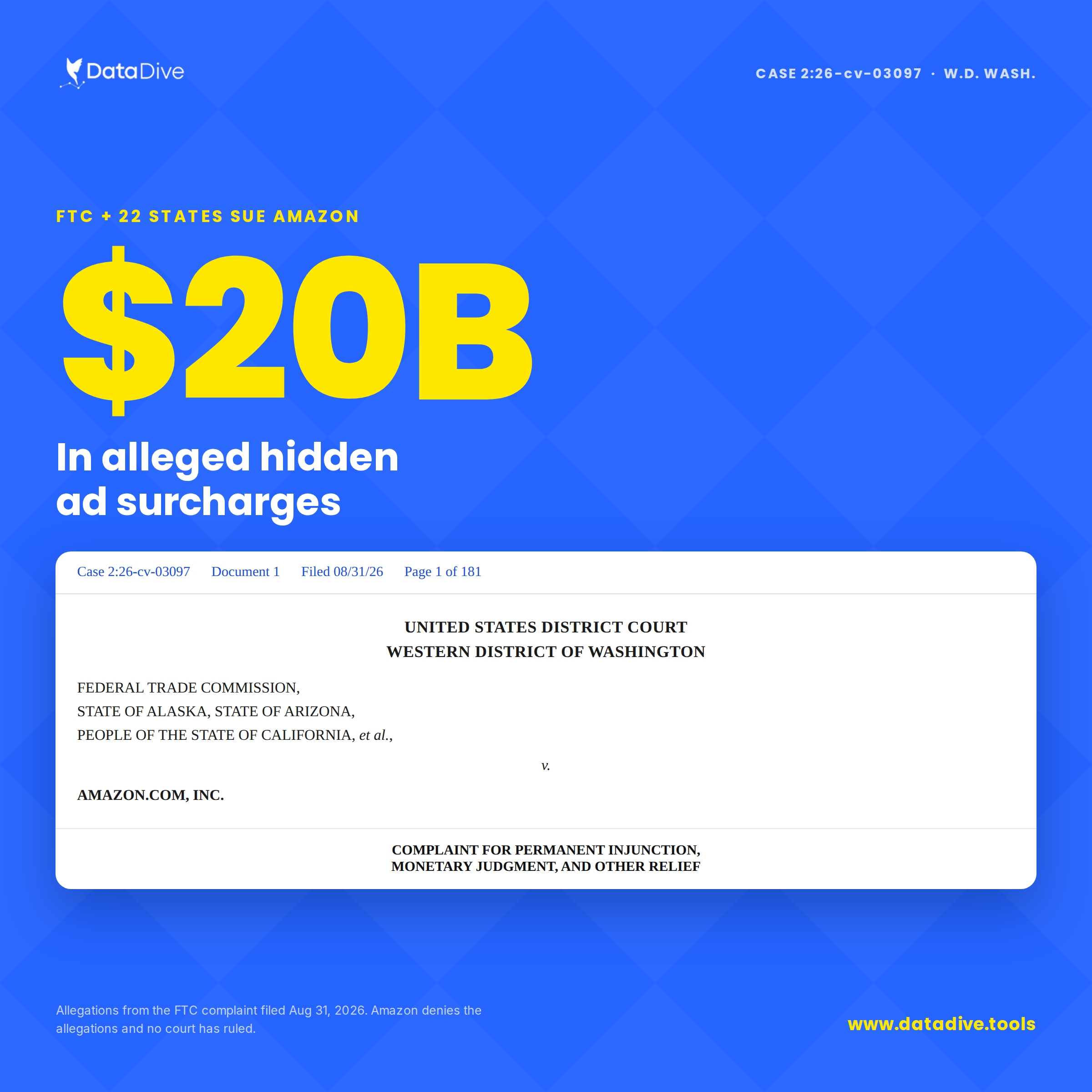
The FTC and 22 states allege Amazon hid surcharges in its advertising auctions for seven years. Amazon denies it. What the complaint says, and what Amazon sellers should do about it.