How to Connect Your Amazon Data to Claude and ChatGPT with the Data Dive MCP
Connect your Data Dive account to Claude or ChatGPT in about a minute. Full setup steps for both, copy-paste prompts, FAQs, and what the MCP can actually do.
The FTC Amazon advertising lawsuit filed on August 31, 2026 accuses the company of quietly inflating what advertisers paid for Sponsored Products, Sponsored Brands and Sponsored Display placements for seven years. Amazon says the case is meritless. Either way, the filing exposes a problem Amazon sellers have had all along.
The short version
On this page
The case turns on one specific piece of auction design.
Amazon told advertisers it ran a second-price auction. In that model, if you bid $1.50 and the next-highest bidder comes in at $1.20, you win and pay $1.21, one cent above the runner-up. The design exists for a reason: it lets you bid what a click is genuinely worth without being punished for honesty, because you almost never pay your maximum.
According to the complaint, that stopped being true in 2019. The FTC alleges Amazon “changed its auction rules without notice,” introducing an undisclosed price floor applied after the auction had already run. They allege Amazon understood exactly what that floor did to advertiser pricing.
The complaint also describes the mechanism used to lift the clearing price: a bidder that, per the FTC, did not exist.
Elsewhere the filing cites internal descriptions of the practice as a “proxy 2nd price that we calculate,” a “clever non-transparent way to charge first price,” and an “incredibly effective way to drive revenue”. All alongside internal warnings about “irrevocable damage to advertiser trust.” Amazon disputes the characterization throughout.
Here are some key excerpts from the FTC complaint:
The complaint’s central number is a share, not a dollar figure. In 2021, the FTC says, 30–40% of Sponsored Products advertisers were charged their own full winning bid. By 2024, that was approximately 80%.
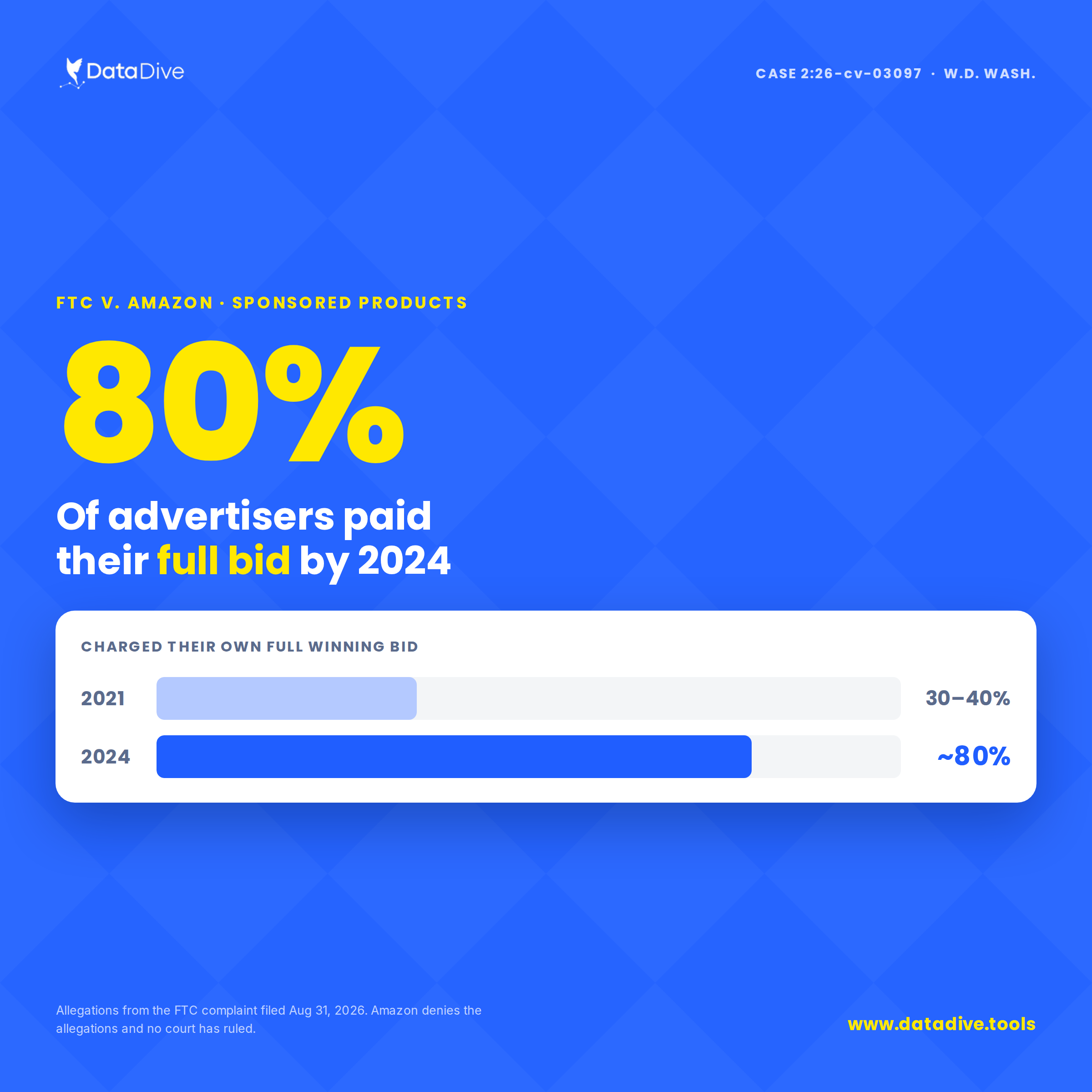
That shift is a shocking revelation to Amazon sellers. If most advertisers pay their maximum most of the time, a “max bid” is functioning as the price, not as a cap. Every incremental test bump becomes a full purchase, as opposed to a rising ceiling.
On scope, the FTC alleges the conduct affected more than one million brands and sellers, including over 500,000 small and medium-sized businesses, and amounted to “tens of billions of dollars.”
Press coverage puts the figure near $20 billion.
The complaint also says surcharges rose on ordinary days and increased far more during Prime Day and Black Friday. These windows are excatly where sellers concentrate budget.
If you are planning for Prime Day and Black Friday, our guide to maximizing Amazon deal day profits is worth a second read in that light.
FTC Chairman Andrew N. Ferguson, announcing the complaint, said Amazon “has millions of advertising customers who were misled into paying significantly higher prices.” The Commission vote was 2–0.
So how is Amazon responding? Here are the key points.
| The FTC alleges | Amazon says |
|---|---|
| An undisclosed surcharge inflated auction prices from 2019 | Advertisers saved over $8 billion from 2021–2025 because the auction weights relevancy, not bid alone |
| Higher costs were largely passed to consumers | The complaint cites no evidence of consumer price increases |
| The mechanic was non-transparent | Generalized second-price dynamics are “the industry standard for decades” |
“Advertisers adjust bids based on real-world performance, not descriptions of auction mechanics.”
— Amazon, responding to the FTC complaint
That is Amazon’s strongest point, and it deserves an honest answer. Experienced sellers do optimize toward outcomes such as ACOS, TACOS, unit velocity, not auction theory. However, if the mechanic underneath those outcomes shifted without notice, every benchmark built from those outcomes shifted with it. You would still be optimizing. You just would not know what you were optimizing against.
None of this has been proven. These are allegations in a civil complaint, Amazon disputes them, and no court has ruled.
So why does this matter? Not because a refund is coming. Cases like this take years, and remedies rarely arrive as a check in a seller’s account. If your plan is to wait and see, that is not a plan. It matters because of what the filing reveals about the structure sellers operate inside.
Think about the decisions you made from advertising data. Break-even bid. Target ACOS by product. The keywords you wrote off as too expensive to chase. Each was calibrated against an effective cost-per-click that, per the complaint, contained an adjustment you were not told about. That does not automatically make those calls wrong. It makes them unverifiable, which is a different and more uncomfortable problem.
When efficiency drops, the reflex (and often the console’s own recommendation) is a higher bid. That reflex is expensive when the clearing mechanic is not visible.
The allegation that surcharges spiked hardest during Prime Day and Black Friday has the most operational bite. Those are the windows where sellers commit the most budget against the thinnest comparable data.
We can see a clear pattern to this activity.
In late August 2026, Amazon began inviting FBA sellers to bid a per-unit amount to add products to its Sub Same-Day network — the 2-to-5-hour delivery service near roughly 2,300 metro areas. Amazon says products in that network see about 12% higher sales versus standard FBA where available. Participation is optional, and Amazon still places some products there for free.
Look at the shape of it. Advertising was the first variable Amazon turned into an auction. Delivery speed is now the second. It follows the same direction as Amazon’s new selection program and the steady tightening of listing rules like the 2026 title requirements: more variables set by Amazon, fewer set by you.
More of your margin is becoming something you bid for, in auctions whose mechanics you do not set and cannot inspect.
Five things. None require a lawyer, but all of them make money whether or not the FTC prevails.
What percentage of your revenue arrives through a click you paid for? Most sellers cannot answer on demand. It is the cleanest measure of exposure to an auction you cannot audit, and revenue that never enters the auction is the only real hedge.
You cannot detect a shift in your economics without a record of your own position over time that does not come from Amazon’s ad reporting. A baseline only helps if it predates the event you are trying to explain, which makes it a today job, not a next-quarter job.
This is the highest-value item on the list, but also risky. Pick eight to ten keywords where you already hold page-one organic placement. Pause paid on those keywords then measure total unit velocity, not ad-attributed sales, which will obviously fall, because you turned the ads off.
NOTE FROM DATA DIVE CEO and 8 FIGURE SELLER
The overlap between where you rank organically and where you are bidding is where budget quietly dies. It is also the fastest ACOS improvement available that does not involve touching a single bid.
If CPC is a variable you do not set, conversion rate is the variable you do. A listing that converts three points better absorbs an inflated click cost and still profits. Most sellers do not have an advertising problem, but rather a measurement problem, with a conversion problem underneath it.
Data Dive has over 10,000 active sellers, and there are key ways to leverage the tools within the software.
Data Dive gives you is an independent record of the variables Amazon’s ad console does not own.
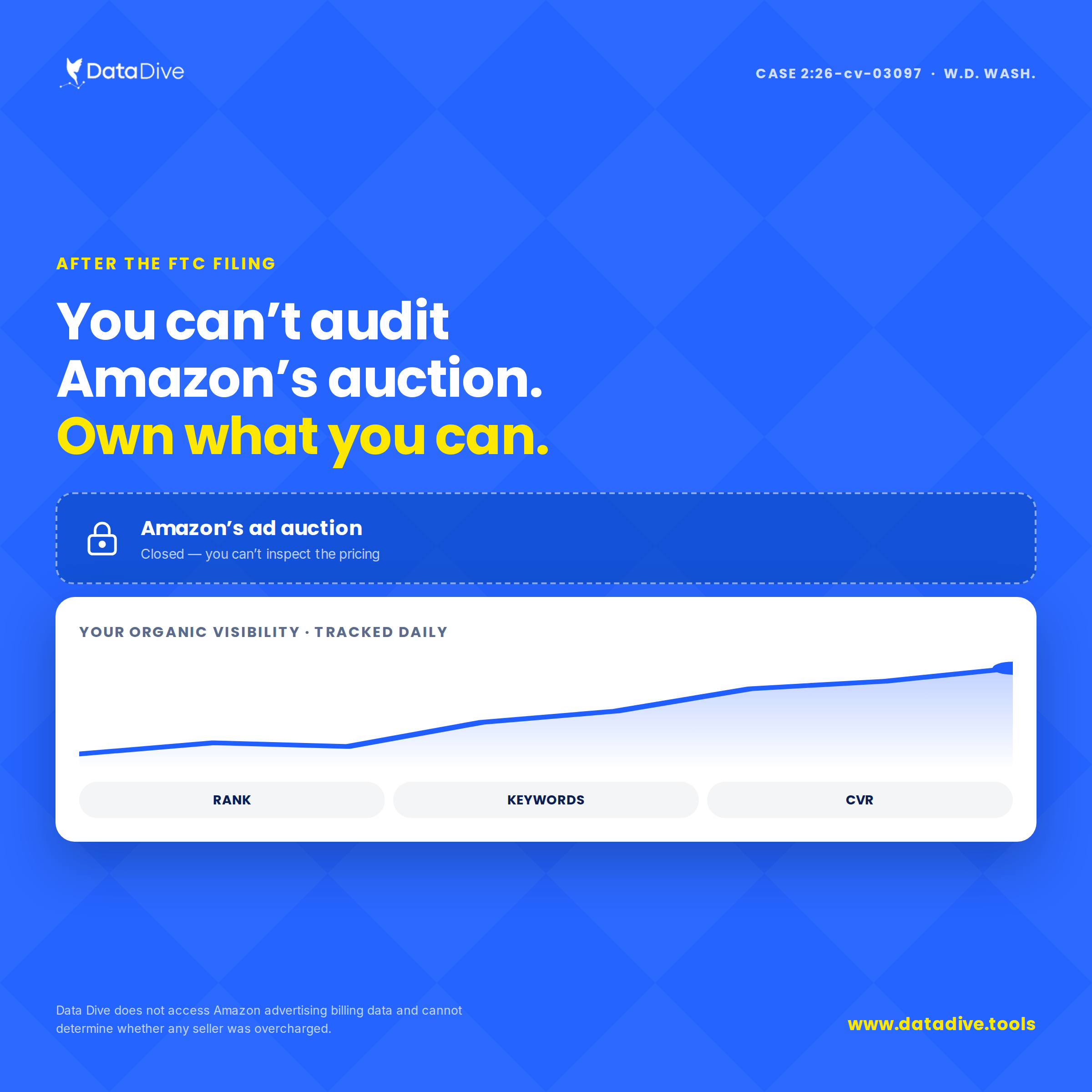
Start your independent rank baseline today
A baseline only helps if it predates the thing you are trying to explain.
The FTC alleges Amazon spent seven years quietly inflating what advertisers paid. Amazon says its auction saved advertisers billions and that the government has shown no consumer harm. A court will sort that out, slowly.
What you can sort out this month is simpler. You have been running a business on numbers supplied by your largest cost center, without an independent check. That was a structural risk before August 31, and it remains one afterward, whatever the verdict. You cannot fix Amazon’s auction. You can fix what you measure.
On August 31, 2026, the FTC and 22 state attorneys general sued Amazon in the U.S. District Court for the Western District of Washington (Case 2:26-cv-03097), alleging that from 2019 Amazon added undisclosed surcharges to its advertising auctions while telling advertisers it ran a second-price auction. The complaint alleges the conduct affected over one million brands and sellers and amounted to tens of billions of dollars. Amazon denies the allegations.
“Soft reserve price” is the term the FTC’s complaint says Amazon used internally for an undisclosed price floor applied after its advertising auctions ran. The complaint also describes an “invented auction participant” and a “proxy 2nd price that we calculate.” The allegation is that these raised the price winners paid above the true second-highest bid. Amazon disputes the characterization.
The FTC alleges that by 2024 approximately 80% of Sponsored Products advertisers were charged their own full winning bid, up from 30–40% in 2021. Amazon denies wrongdoing and says advertisers saved over $8 billion from 2021 to 2025 because its auction weights ad relevancy rather than bid alone. The allegations have not been proven in court.
There is no basis to expect one. The case was filed on August 31, 2026 and litigation of this type typically takes years. No remedy has been ordered, and sellers should plan their advertising economics on the assumption that nothing about their cost structure changes as a result.
Track organic-to-paid revenue ratio as a KPI, establish an independent daily organic rank baseline, run an incrementality test by pausing paid on keywords where you already hold page-one organic placement, eliminate redundant spend where paid and organic overlap, and invest in conversion rate through listing quality. These improve profitability regardless of the lawsuit’s outcome.
Choose eight to ten keywords where your product already ranks on page one organically, pause paid advertising on those keywords for fourteen days, and measure total unit velocity rather than ad-attributed sales. If total velocity holds steady, that paid spend was largely buying clicks you would have won organically.
In late August 2026, Amazon began inviting FBA sellers to bid a per-unit amount to add products to its Sub Same-Day network, which delivers in 2–5 hours near roughly 2,300 metro areas. Amazon says products in the network see about 12% higher sales versus standard FBA delivery where available. Participation is optional and sellers pay only for units that ship through the service, at the price they bid.
No. Data Dive does not ingest Amazon advertising billing data and cannot determine whether any seller was overcharged. It provides independent measurement of organic keyword rank, the keyword landscape, competitor events, and listing conversion factors — the variables that do not come from Amazon’s advertising reporting.
This article describes allegations in a civil complaint filed by the Federal Trade Commission and 22 state attorneys general on August 31, 2026 (Case 2:26-cv-03097, W.D. Wash.). Amazon has publicly denied the allegations and no court has ruled on them. Nothing here is legal advice. Amazon’s advertising mechanics and program terms change over time — confirm current details in Seller Central before making any bidding or budget decision.
Connect your Data Dive account to Claude or ChatGPT in about a minute. Full setup steps for both, copy-paste prompts, FAQs, and what the MCP can actually do.

Brandon Young went backstage at Amazon Accelerate 2026 as an Amazon partner. Time to Prime, AI auto-optimization for PPC, and why new launches drove 16% of third-party seller revenue.