Compare Like With Like: Date Range Mistake That Makes Good Rank Data Look Wrong
Most rank arguments are date range arguments. Brandon Young on comparing like with like, and a weekly routine that makes rank data clear.
Brandon Young
CEO and Co-founder, Data Dive
Black Friday weekend is the easiest weekend of the year to fool yourself.
Traffic jumps. Conversion jumps. Ad costs jump. A seller can look at one good day, decide the product is winning, and spend the next two weeks paying for that decision.
Or you can look at one bad morning, pull budget that was working, and hand the weekend to a competitor.
The weekend is not the problem. Reading it in slices is the problem.

Brandon Young presenting on using advanced data to improve PPC advertising and profitability.
In short: Write your measurement rules down before Black Friday: a fixed comparison window, rank read together with Search Query Performance and PPC data, decisions judged on contribution dollars, and stop and scale rules set in advance.
BLACK FRIDAY + CYBER MONDAY
$100 OFF STANDARD
Use code BFCM26AFF
New customers only. Expires November 30, 2026 at 11:59 PM EST.
My process has not changed in a decade. Data first, then identify the opportunity or the risk, then build a repeatable process, automate, measure, and improve.
That process matters more on Black Friday, because everything moves at once. Write the rules down while the numbers are still calm.
Compare the event against the same length window before it, and against the same event last year if you have it.
Organic rank tells you where you showed up. Search Query Performance tells you what shoppers searched, clicked, and bought. PPC data tells you what you paid to influence that result.
A campaign can hit its target cost and still lose money once the discount, higher click prices, and returns come home.
Decide today what makes you add budget, what makes you hold, and what makes you stop before the event starts influencing your mood.
Data Dive now tracks more than 3.9 million keywords every day across more than 58,000 ASINs.
Daily matters on a weekend like this. Rank does not move once a week in late November, and a weekly report tells you what happened after the money is already spent.
When you can see rank, shopper demand, and paid performance together, you can separate a product gaining real share from one simply renting sales at event prices.
Rank Radar brings organic rank, impression rank, PPC information, and Search Query Performance into the same analysis workflow.
Rented sales end when the budget ends.
Share stays.
$100 OFF
Standard tier for new customers
Expires November 30, 2026 at 11:59 PM EST. New customers only.
That is the whole offer. No countdown clock, no inflated list price, and no fine print trick.
If you have been meaning to get rank, demand, and advertising data into one place before the biggest selling stretch of the year, this is a cheaper week to start. If your current setup already gives you that view, keep it and spend the money on inventory.
Most sellers will spend Cyber Monday night celebrating or panicking, and both reactions waste some of the best data of the year.

Brandon Young speaking to Amazon sellers about data-driven marketplace strategy.
The event weekend shows which search terms actually convert for your product, which competitors take share when prices move, and where your listing holds up under heavy traffic.
Check whether those terms are in your listing and campaigns on purpose, or whether they generated sales by accident.
Decide whether each gap is a price problem, relevance problem, review problem, or another advantage you need to understand.
Write down what those rules got right and wrong while you still remember why you made each decision during the event.
The sellers who win the next year are not always the ones who won the weekend. They are the ones who read it correctly.
Plan the read before the weekend starts. That is the job.
Set the rules before the event, use equal comparison windows, read organic rank alongside SQP and PPC data, and judge contribution dollars alongside advertising metrics.
A campaign can hit its target ACOS while discounts, higher click prices, returns, and longer term organic effects change the actual profitability.
Review converting search terms, competitor ranking gaps, and what your predetermined stop and scale rules got right and wrong.
New customers can take $100 off the Standard tier using code BFCM26AFF through November 30, 2026 at 11:59 PM EST.
Compare Like With Like: See why mismatched date ranges can make accurate rank data tell the wrong story.
Data Dive Tracks More Than 3.9 Million Keywords Every Day: Learn how daily rank, SQP, PPC, alerts, and connected data support marketplace decisions.
Data Dive Indexing Alerts: Learn how Data Dive surfaces listing indexing problems before lost visibility becomes a larger sales issue.
Data Dive is the operating system for ecommerce sellers.
Built by operators who have sold on Amazon since 2015, Data Dive combines product research, keyword intelligence, daily organic rank tracking, Search Query Performance data, and advertising data.
Learn more at datadive.tools.
Most rank arguments are date range arguments. Brandon Young on comparing like with like, and a weekly routine that makes rank data clear.
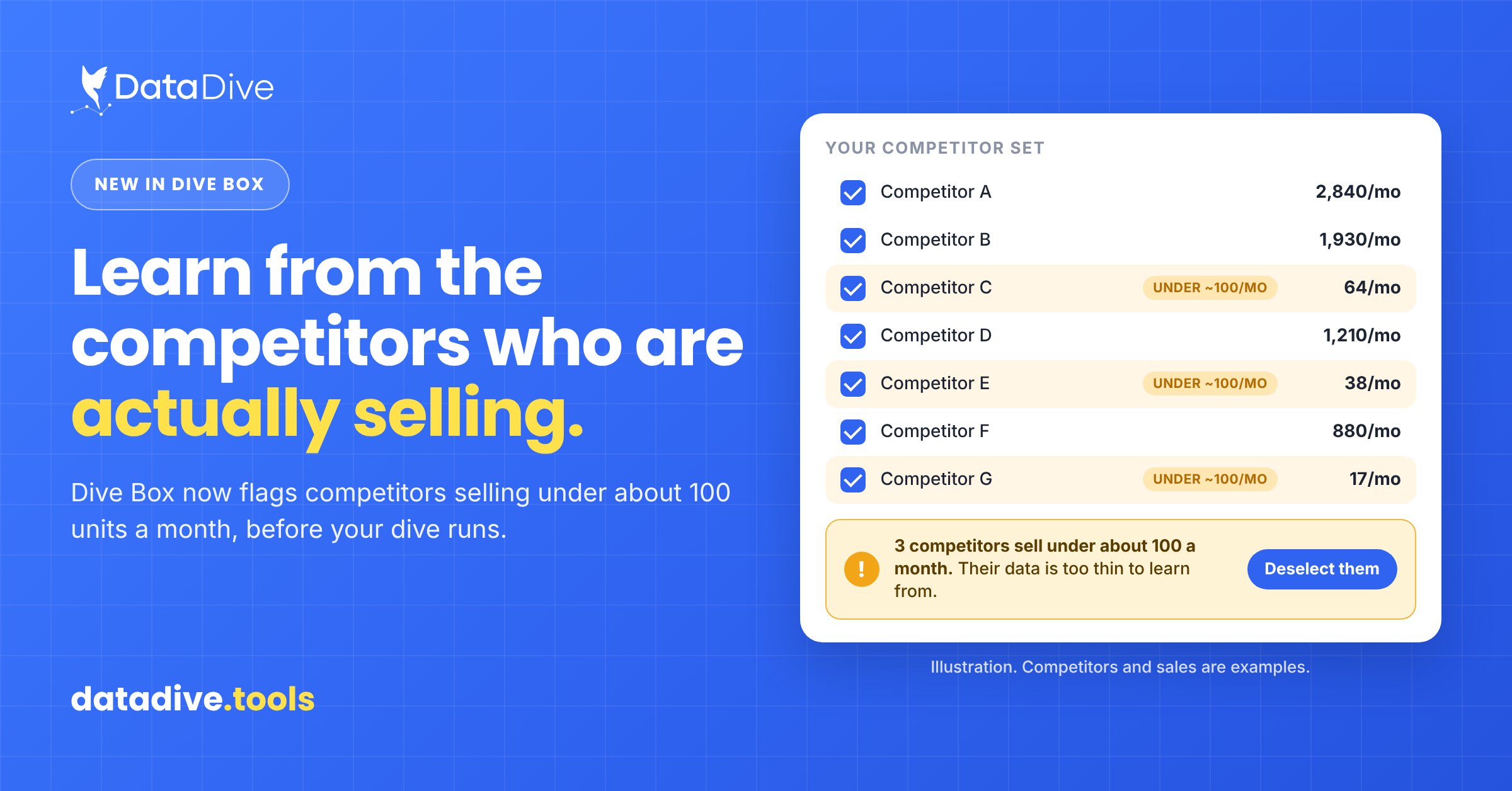
Data Dive’s Dive Box now warns you about competitors selling under about 100 units a month before a dive runs, so you learn from the sellers who are actually selling.