Compare Like With Like: Date Range Mistake That Makes Good Rank Data Look Wrong
Most rank arguments are date range arguments. Brandon Young on comparing like with like, and a weekly routine that makes rank data clear.
Data Dive is approaching four million daily tracked organic keywords across more than 58,000 Amazon ASINs on its platform.
The platform now tracks more than 3.9 million keywords every day while connecting rank, demand, and advertising performance.
That information increasingly flows into alerts, internal dashboards, reporting systems, and AI tools already used by Amazon operators.
For brands and agencies managing larger catalogs, daily data becomes an operating input instead of another static reporting layer.
Amazon businesses increasingly manage extensive catalogs, large keyword universes, and advertising budgets that move throughout each operating day.
Teams need current visibility into market position, movement, competitive pressure, and the specific actions influencing those changes across products.
Daily tracking at this scale moves ranking information closer to operational decision making instead of leaving it inside historical reports.
Data Dive brings daily organic rank together with Search Query Performance and PPC data inside its keyword tracking workflow.
Organic rank shows where a product appears, while SQP adds demand signals and advertising data explains paid marketplace activity.
Viewed together, those signals help sellers understand whether visibility, shopper demand, and advertising support are moving in the same direction.
Rank Radar lets users combine organic rank, impression rank, PPC metrics, and SQP information through its Data Options controls.
Product Performance summarizes organic rank averages alongside Top 10 and Top 50 keyword visibility across the selected period.

“Most tools show you one slice of the market and ask you to guess the rest.”
“We track the keyword universe daily, and then we connect it to the data that explains it. When you can see organic rank, Search Query Performance, and advertising performance together, you stop arguing about opinions. You can see the levers. You can see where share is available, where money is working, and where money is leaking.”
Brandon Young, CEO and Co founder, Data Dive
The next stage for Data Dive focuses on moving marketplace information beyond one dashboard into the systems teams already operate.
Through Data Dive MCP and API connections, teams can bring research and account information directly into connected workflows and AI tools.
That includes keyword rankings, competitor research, account information, reports, and supported advertising data available through connected Data Dive resources.
Instead of copying numbers between tools, operators can build reporting, analysis, and approved actions around the data already being tracked.
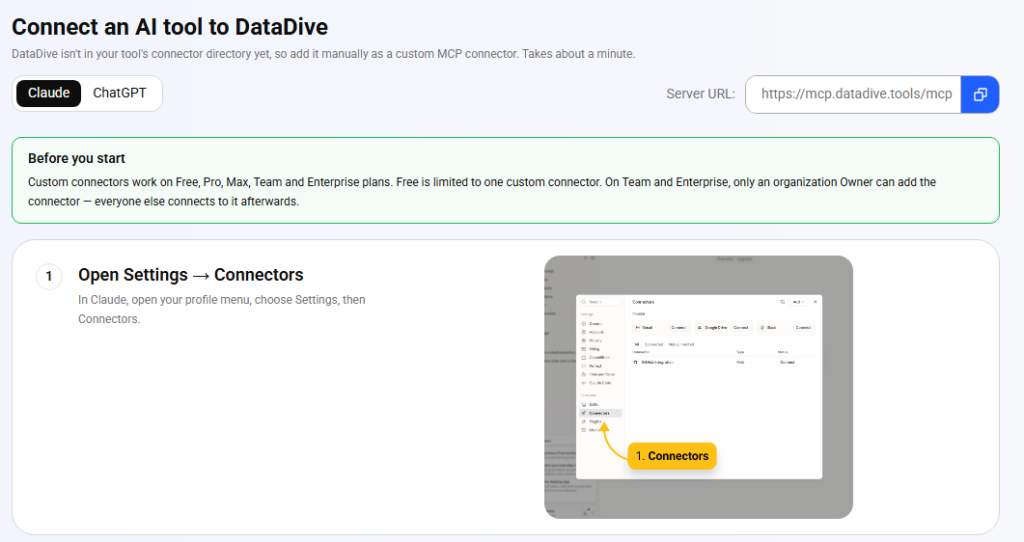
Data Dive MCP connects supported AI tools directly with Data Dive data through an authorized account connection.
Connected data becomes more valuable when important changes reach teams without requiring someone to repeatedly open another reporting dashboard.
Data Dive’s webhook alerts can push notifications into external workflows, beginning with channels such as Slack.
The platform also surfaces indexing problems, helping teams identify visibility issues before those problems remain unnoticed across longer periods.
The broader goal is moving important marketplace changes closer to the people, systems, and workflows responsible for acting on them.

The Alerts dashboard surfaces indexing issues across products so teams can review affected ASINs from one place.
Teams can evaluate how individual ASINs and keywords are performing against current marketplace movement instead of relying on older snapshots.
Organic visibility, shopper activity, purchases, and paid performance can be considered alongside competitors appearing across the same search results.
Connected information can reveal keywords approaching stronger positions, terms needing additional support, and areas where competitors appear vulnerable.
Advertising spend can be evaluated against ranking movement, sales, and share to identify where budget appears productive or inefficient.
“Sellers are building real systems now.”
“They have their own dashboards, their own AI workflows, and their own ways of running a brand. Our job is to be the data layer underneath all of it. The richest, most current view of the Amazon market, delivered wherever they make decisions. Crossing 4 million keywords tracked daily is not the finish line. It is the foundation for everything that gets built on top of it.”
Brandon Young, CEO and Co founder, Data Dive

Data Dive serves more than 10,000 paid users, ranging from individual brand owners to larger agencies and Amazon aggregators.
The platform has been live since 2022 and continues expanding how marketplace data can support connected operating workflows.
Data Dive is an operating system for ecommerce sellers, combining marketplace research, ranking intelligence, account data, and connected workflows.
Its tools support product research, keyword intelligence, daily organic rank tracking, Search Query Performance, advertising analysis, and listing optimization.
Learn more about the platform, current features, and available workflows at datadive.tools.
Data Dive reports tracking more than 3.9 million organic keywords every day across more than 58,000 Amazon ASINs.
Rank Radar can combine organic rank information with PPC metrics and Search Query Performance information when those connections are available.
Yes, Data Dive MCP can connect supported Data Dive information with compatible AI assistants and authorized external workflows.
Current alert workflows include indexing issues, advertising blind spots, competitor changes, and notifications delivered through connected webhook integrations.
Data Dive launched in 2022 after being founded to support Amazon sellers with structured research and optimization workflows.
Connect Data Dive to Claude and ChatGPT: See how MCP brings connected Amazon research directly into supported AI tools and workflows.
Data Dive Webhook Alerts: Learn how alerts can move into Slack and other external systems without requiring constant dashboard checking.
Data Dive Indexing Alerts: Review how Data Dive identifies listing indexing problems and provides context for resolving affected Amazon products.
Most rank arguments are date range arguments. Brandon Young on comparing like with like, and a weekly routine that makes rank data clear.
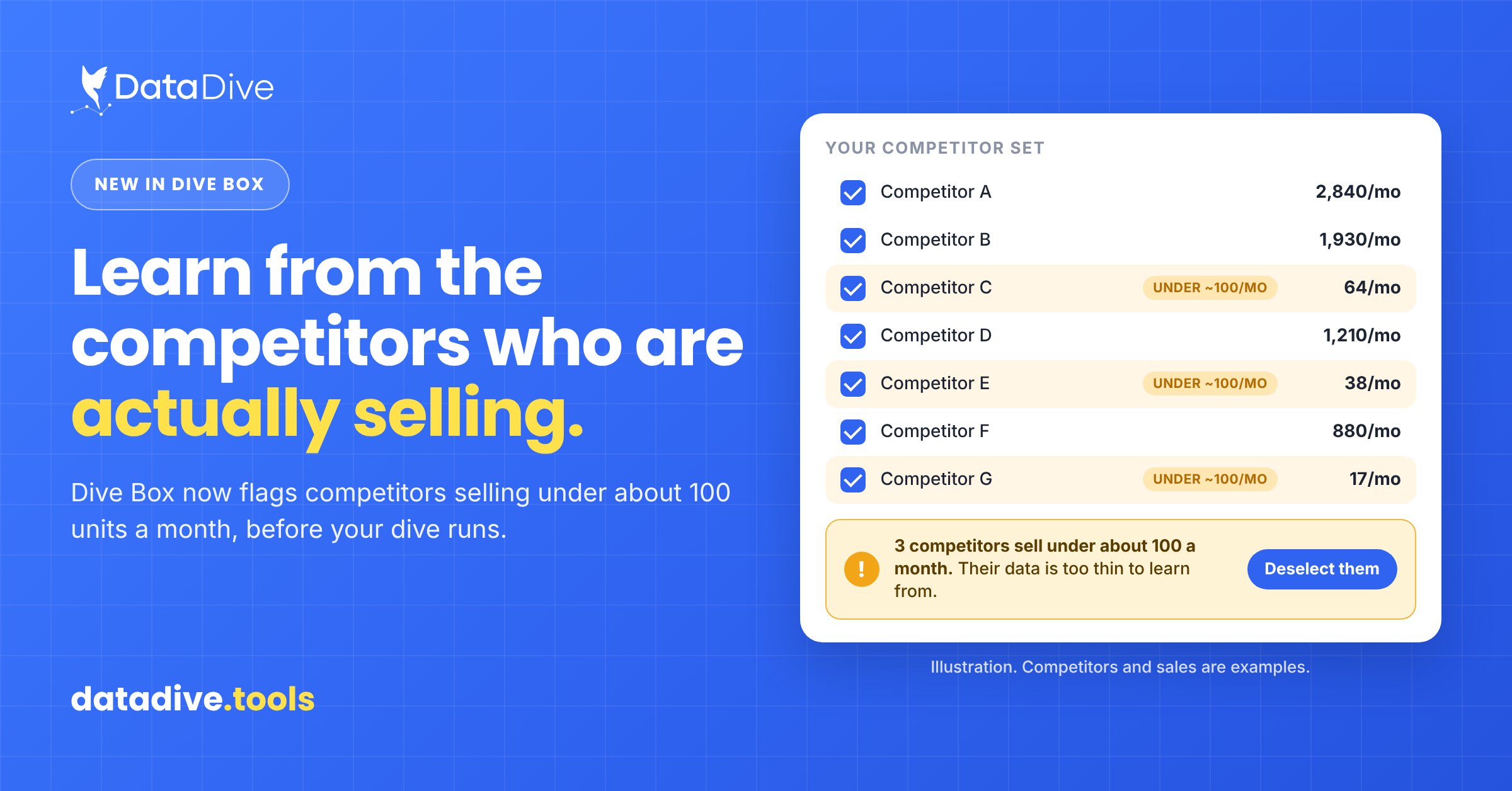
Data Dive’s Dive Box now warns you about competitors selling under about 100 units a month before a dive runs, so you learn from the sellers who are actually selling.