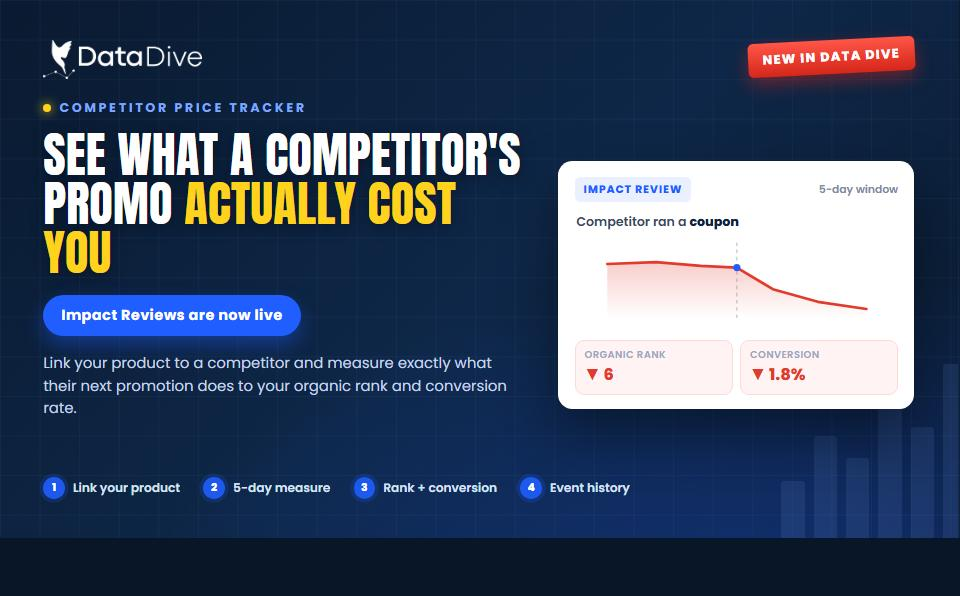
Data Dive’s Competitor Price Tracker Now Gives Impact Review What a Competitor’s Promo Actually Cost You
Your rank slipped last Tuesday. Was that something you did, or something a competitor did? Until now, Competitor Price Tracker could tell

Starting from zero on Amazon can feel confusing at first because there are many moving parts. Most beginners think the first step is opening an account or finding a supplier. That is not where success starts.
Success on Amazon starts with understanding how the platform works.
Amazon is driven by search behavior. Customers come in already looking for something. They type in keywords, compare options, and make decisions quickly. If you do not understand how those decisions happen, you will struggle to get traction no matter how good your product looks.
The goal is to follow a structured process. When you understand how to choose a product, how to improve it, and how to launch it properly, Amazon becomes much easier to navigate.
The first step is product selection, and this is where most people go wrong.
You cannot create demand on Amazon. You have to choose a product that is already selling. The opportunity comes from understanding how current sellers are getting their sales and identifying where you can compete.
This requires looking at data.
You need to understand how customers search for a product. A single product can have multiple variations depending on how people describe it. For example, a diaper bag can be searched as a backpack, a tote, or based on features or use cases.
Each of these variations represents a different entry point into the market.
When you analyze a product, you need to break it down into these sub niches. Some segments may be too competitive, especially if strong brands dominate the space. Others may offer a clearer opportunity if there are gaps in how competitors are positioned.
Tools like Data Dive help you see how top sellers are ranked across keywords and how they are generating their sales.
The goal is not to copy what already exists. The goal is to understand how the market works and decide whether there is room for you to enter.
Choosing the right product sets the foundation for everything else on Amazon.
You cannot create demand on Amazon. You have to choose a product that is already selling. The opportunity comes from understanding how current sellers fall short.
Once you identify a potential product, the next step is figuring out how to improve it.
You cannot enter Amazon with the same product and expect to perform well. You need a clear reason for customers to choose your product over others.
This starts with analyzing existing listings and customer feedback.
Reviews provide direct insight into what people like and what they wish was better. These insights help you identify gaps that you can address.
Improvement can come in different forms.
You might enhance quality, add useful accessories, or refine the design. Even small changes can make a difference if they solve a real problem for the customer.
Packaging is another factor.
In some categories, products are often purchased as gifts. If your packaging is better and clearly shown in your listing, it can influence buying decisions.
You also need to understand who is buying the product.
In some cases, the buyer and the user are not the same person. That changes how you position the product and how you present it on Amazon.
The goal is to create something that stands out clearly when compared side by side with competitors.

Before investing in inventory, you need to validate your idea.
Many beginners skip this step and go straight into production. This creates unnecessary risk.
A better approach is to test your concept first.
You can create mockups of your product and show them to potential customers. Ask them which option they would choose when compared to existing products.
If your product does not stand out, you go back and improve it.
If it does stand out, you move forward with more confidence.
This step helps you avoid investing in products that do not resonate with buyers.
Validation is about reducing risk before committing capital.
Validation is about reducing risk before committing capital. Once your product is in Amazon warehouses, changes become much harder to make.
Once your product is in Amazon warehouses, changes become much harder to make. Testing early gives you flexibility and saves money.
Ready to find your first winning product? Data Dive gives you the data, insights, and tools to make confident decisions from day one.
After validating your product, the next phase is execution.
Costs need to be calculated carefully. Manufacturing is only one part. You also need to consider shipping, logistics, storage, and advertising.
You need to work backwards from your selling price.
Look at what competitors are charging on Amazon. Then calculate all your costs and determine whether the product is financially viable.
Pricing needs to stay competitive while still allowing for profit.
Inventory planning is another key part of this stage.
Production and shipping can take several weeks. You need enough inventory to cover that time period. Running out of stock can hurt your performance and reduce visibility.
Shipping methods also affect your costs.
You can send products directly into Amazon or use a third-party warehouse to manage inventory. Each option has trade-offs.
Once your inventory arrives, you move into the launch phase.
Amazon requires advertising from the beginning. You need to run campaigns targeting multiple keywords to generate traffic and signal performance.
This helps your product gain visibility and improve ranking.
Amazon requires advertising from the beginning. You need to run campaigns, monitor performance, and adjust your strategy based on what drives results.
You also need to monitor performance.
Some keywords will perform better than others. You need to adjust your strategy based on what drives results.
Launching is not a one-time action. It is the beginning of ongoing optimization.
Starting from scratch on Amazon comes down to following a structured process.
1. Choose a Winning Product — Find products with proven demand where current sellers leave room to compete.
2. Create a Competitive Edge — Differentiate through design, packaging, and listing quality.
3. Validate Before You Invest — Test your concept with real feedback to reduce risk.
4. Launch With Structure — Manage costs, inventory, and promotions with a clear system.
You begin by choosing a product that already has demand. You analyze how current sellers are generating sales and identify where you can compete. You improve the product so it stands out. You validate the idea before investing in inventory. Then you manage costs, plan inventory, and execute a strong launch.
Each step builds on the previous one.
Skipping steps increases risk and reduces your chances of success. Following the process gives you a clearer path forward.
Amazon provides access to a large number of customers, but results depend on how well you understand and apply these fundamentals.
When you approach it with structure and discipline, you move from uncertainty to a repeatable system that can grow over time.
Your rank slipped last Tuesday. Was that something you did, or something a competitor did? Until now, Competitor Price Tracker could tell

Amazon caps product titles at 75 characters on July 27, 2026. Here’s the full change, why it matters, and the step-by-step fix using Data Dive.